

Kenya secures 4,500 Hajj slots after new deal with Saudi Arabia
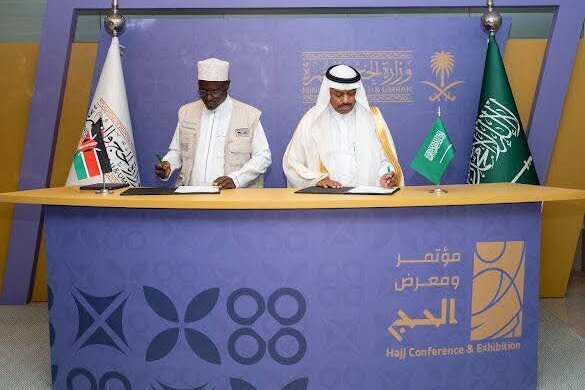
Supreme Council of Kenya Muslims (SUPKEM) Chairman Sheikh Hassan Ole Naado (left) during signing of the Memorandum in Jeddah, Saudi Arabia on Friday, November 7, 2025. Photo/Courtesy
Kenya’s Muslim community has received a major boost after the Supreme Council of Kenya Muslims (SUPKEM) signed a Memorandum of Understanding (MoU) with Saudi Arabia’s Ministry of Hajj and Umrah, guaranteeing 4,500 slots for the 2026 Hajj season.
The agreement, signed in Jeddah, paves the way for more Kenyan pilgrims to fulfil one of Islam’s five pillars in the 1447 Hijri year.
It also strengthens bilateral relations between Kenya and the Kingdom of Saudi Arabia on matters of faith and religious cooperation.
SUPKEM National Chairman and President of the Kenya Hajj Mission, Sheikh Hassan Ole Naado, who led the Kenyan delegation, described the agreement as “a profound opportunity for spiritual rejuvenation and unity.”
“This partnership signifies our commitment to enhancing the Hajj experience for our pilgrims and deepening ties between Kenya and Saudi Arabia,” Sheikh Naado said.
He was accompanied by SUPKEM Secretary General Sheikh Abdullahi Salat and Kenya’s Deputy Consul General in Jeddah Mr Jillo Falana.
The Saudi delegation was led by Dr Abdulfattah Suliman Almashat, the Deputy Minister for Hajj and Umrah Affairs.
The MoU sets a clear framework for coordination between SUPKEM and Saudi authorities on logistical, welfare, and administrative arrangements.
It also commits SUPKEM to ensure transparency and better value for money for Kenyan pilgrims.
Sheikh Naado said preparations for the 2026 pilgrimage will begin early, with an emphasis on training, medical checks, and pre-departure orientation to improve the experience for all pilgrims.
“Our focus is on ensuring every Kenyan pilgrim enjoys a smooth and spiritually fulfilling journey from the time they register to their return home,” he added.
The signing also reflects growing cooperation between Nairobi and Riyadh in religious and social development.
Sheikh Naado expressed gratitude to Kenya’s Ministry of Foreign and Diaspora Affairs and the Saudi Embassy in Nairobi for facilitating the process.
Hajj, one of the five pillars of Islam, is a sacred duty that every Muslim must perform at least once in their lifetime if physically and financially able.
For Kenyan Muslims, the new allocation comes as a relief following years of high demand and logistical bottlenecks in securing slots.
The Kenya Hajj Mission will now begin internal coordination to allocate the slots fairly among travel agencies and regional Muslim councils ahead of the 2026 pilgrimage.
To advertise with us, send an email to advert@avdeltanews.world