

Why ODM had to postpone its 20th celebrations
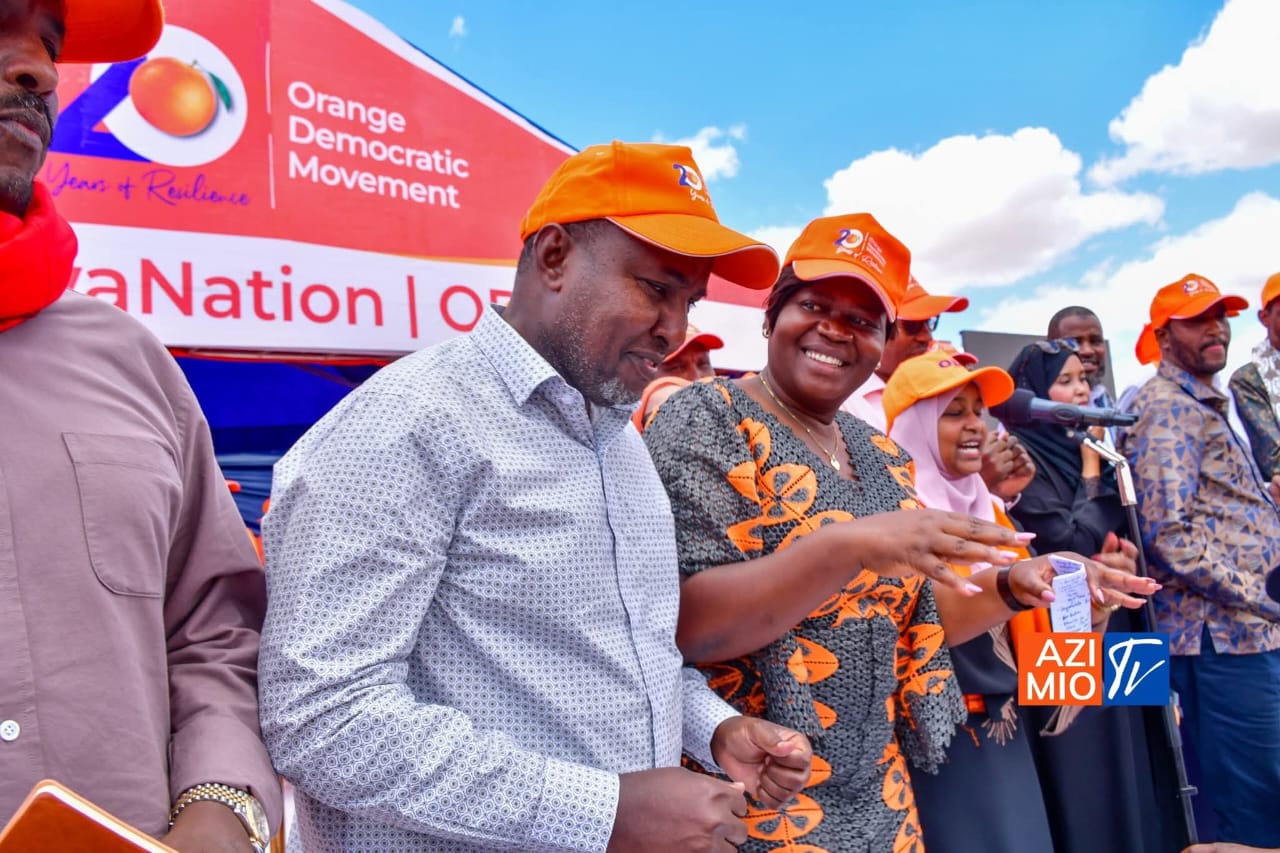
ODM @20 Committee chairman Junet Mohamed abd party National Chairperson Gladys Wanga during a recent event. Photo/File.
The Orange Democratic Movement (ODM) has postponed its 20th-anniversary celebrations in Mombasa from October 10-12, 2025, to November 14-16, 2025.
According to Chairman of the ODM@20 Planning Committee, Mr Junet Mohamed, the decision followed consultations with ODM Party Leader Raila Odinga.
"The move is meant to give room for more county-level activities ahead of the grand event," said Mr Mohamed in a letter.
Instead of a single three-day gathering, ODM will now roll out build-up celebrations in Kajiado, Turkana, Kilifi (Magarini), Nairobi, and other counties, before converging in Mombasa for what the party calls a “people-driven” national anniversary.
Leaders say the approach will allow more members across the country to participate and strengthen ODM’s image as a grassroots movement.
The party’s anniversary carries symbolic weight. ODM was born out of the 2005 constitutional referendum, when the Orange campaign opposed former President Mwai Kibaki’s draft constitution.
That movement morphed into a political party, later splitting in 2007 to form ODM and ODM-Kenya (now Wiper).
Under Mr Odinga’s leadership, ODM has been at the centre of major coalitions, elections, and national debates over the last two decades.
Yet the postponement has also exposed rifts. Critics, including Suba South MP Caroli Omondi, have argued that ODM risks losing its edge if it does not confront questions of inclusivity, internal democracy, and discipline.
"Some MPs stayed away from earlier anniversary build-ups in Kisii, underscoring the party’s fragmented support base," said Mr Omondi.
ODM leaders maintain that the anniversary is about renewal and unity. Mr Odinga has framed the celebrations as a chance to “reaffirm ODM’s values of social democracy, fairness, and the fight against corruption.”
National Chair Ms Gladys Wanga and Secretary-General Edwin Sifuna have also insisted that ODM’s mission of defending constitutional gains and advancing economic justice remains intact.
Since ODM signed a Memorandum of Understanding (MoU) with UDA in March 2025 for a working arrangement, mounting criticisms from within ODM and from its critics have framed the pact not as “broad-based” but rather “bread-based” — meaning many perceive that only leaders close to the top are benefiting materially or politically, while ordinary supporters are sidelined.
Senator Sifuna has condemned the agreement as exercised in name only, saying it has become “of no use”.
He pointed out that despite clauses in the MoU pushing for accountability and protection of civil liberties, incidents such as extra-judicial killings and the killing of Albert Ojwang while in police custody show that the agreement has not delivered on its promised reforms.
Embakasi North MP James Gakuya, an ally of UDA, described the pact as “selfish”.
"We expected that the arrangement would address systemic challenges confronting ordinary Kenyans. This is not the case " said Mr Gakuya.
He claimed that much of the benefit has gone to those in leadership and that for many, nothing tangible has changed.
ODM's technical team, established to monitor implementation of the 10-point MoU agenda, has highlighted missing linkages: slow progress on the National Dialogue Committee report (NADCO), delays in fulfilling rights to peaceful assembly, and weak enforcement of anti-corruption measures.
Critics say these are signs that the agreement’s mechanisms are not working as intended.
Kisumu Governor Anyang’ Nyong’o has defended the arrangement, pointing out that cooperation is necessary for national stability and governance.
Yet even among defenders, there’s caution: many warn that unless benefits trickle down beyond high offices and ceremony, the “bread-based” criticism will deepen disillusionment.
The Mombasa anniversary is therefore more than a party celebration — it is a test of ODM’s resilience.
Whether the postponement will build momentum or deepen scepticism depends on how successfully the party reconnects with disillusioned supporters in the counties and rallies them behind its 2027 strategy.
To advertise with us, send an email to advert@avdeltanews.world