

DP Gachagua to face Senate after court declines to stop his impeachment
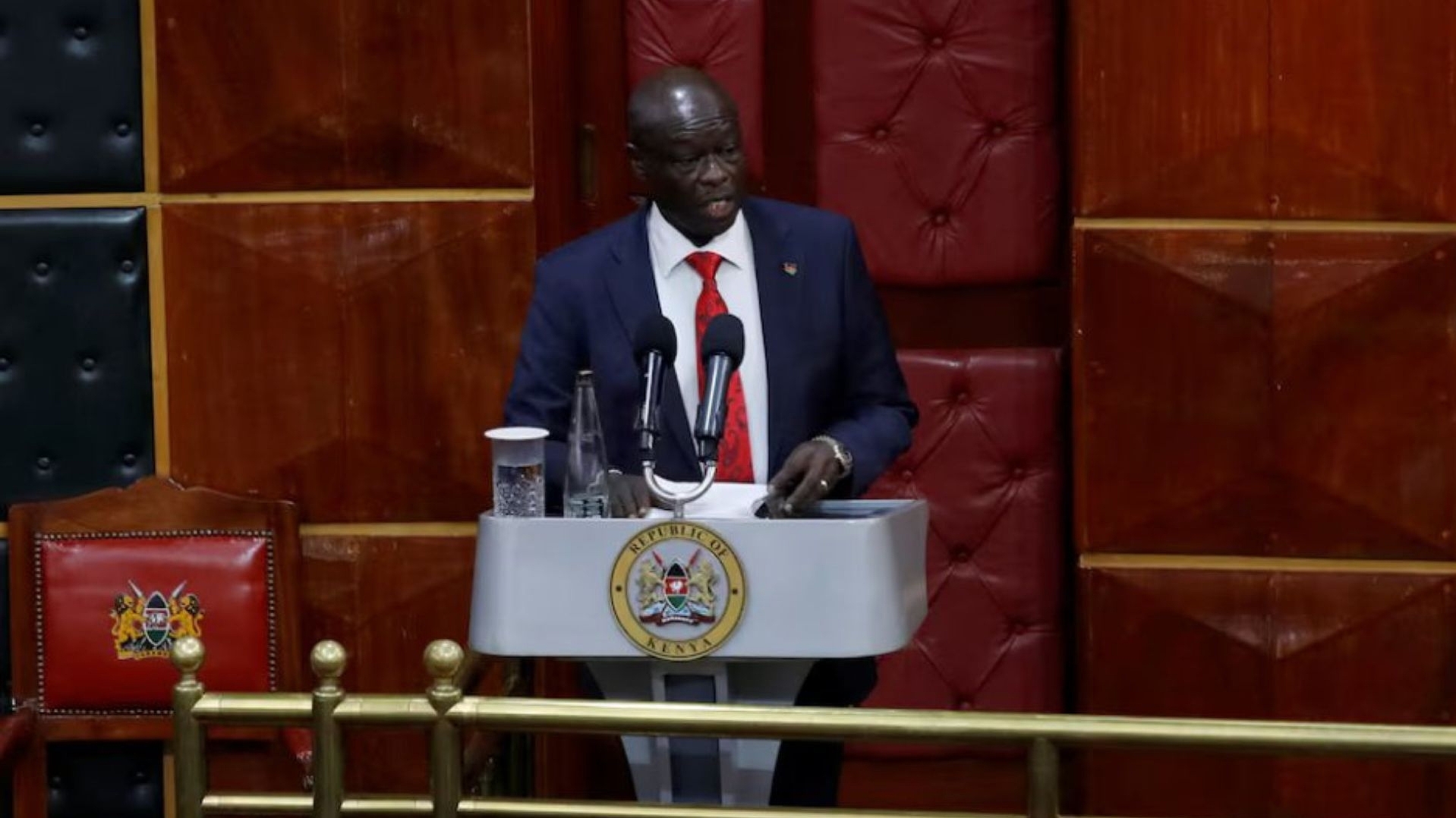
Deputy President Rigathi Gachagua. File photo
The High Court has turned down Deputy President Rigathi Gachagua’s ‘premature’ application to stop the Senate from proceeding to impeach him on Wednesday (today) and Thursday.
A three-judge bench comprising justices Eric Ogola, Freda Mugambi and Anthony Mrima said they are being called upon to anticipate the outcome of a process yet to be completed.
The multi-judge bench on Wednesday said Gachagua’s application is premature and anticipatory.
Gachagua had argued that the proceedings are unconstitutional and the Parliament has violated his constitutional rights and the proceedings should be suspended, pending hearing of his application to have them permanently terminated.
He says the impeachment exercise is riddled with irregularities and illegalities and terms the process unconstitutional for “gross violation of his rights”.
The embattled DP had told the judges that the National Assembly violated his rights on fair administrative action and hearing under Article 50 (1), adding that if impeached, he will be unsuitable to hold a public office thereafter and urged the court to protect his rights in Article 38 of the Constitution.
But the judges differed with him on his argument that he is going to suffer irreversible loss because the impeachment will be politically fatal.
In unanimous ruling, the judges said no prejudice will be suffered by the applicant (Gachagua) if the orders are not granted at this stage and he will still have opportunity to seek redress if not satisfied with the outcome of the exercise in the Senate.
“The (impeachment) process is a lawful constitutional process and the Senate will conduct a trial, whereupon the issues being raised before the court will be raised and determined,” the judges said.
“Should the petitioner (Gachagua) not succeed, the petitioner will still have an opportunity to approach the court after the process.”
They said that the issues before them were canvassed before a court of similar competency and convergent jurisdiction.
The matters were heard before Justice Chacha Mwita who on Tuesday declined to stop the impeachment as sought by Mr Gachagua.
The second in command had argued that as soon as the Senate impeaches him, he will cease to hold the office immediately and will be unable to proclaim it after the court process.
But justice Ogola who delivered the bench’s verdict said that Mr Gachagua’s application will still have remedy because “the assumption of the office cannot oust the court’s jurisdiction".
"The court has unfettered jurisdiction to check on the constitutionality of the process at whatever stage,” justice Ogola said.
The bench said that it finds that exercising its restraint at this stage will enhance and allow the independent institutions of government to function in their fullness except in the clearest of cases.
“It is our view that this is not one(1) such case where intervention is automatic. The issues raised by the parties will require to be interrogated. We therefore find that the enhancement of the constitutional principle of separation of powers will be best found by declining the application at this point,” the judges ruled.
Justice Ogola said the determination to be made by the court will not be out of time as argued by Mr Gachagua through his lawyers led by senior counsel Paul Muite and Ndengwa Njiru.
The judges said the court is still able to grant a remedy even after the process is conducted and concluded and as such, the court will not be acting in vain.
“The public interest tilt in allowing the constitutional processes to proceed unhindered,” the judges said.
Lawyers had on Tuesday night made a passionate appeal to the bench to issue conservatory orders temporarily stopping the Senate from considering the National Assembly’s resolution to impeach the DP.
But the pleas were strongly opposed by National Assembly’s lawyer Paul Nyamondi and Speaker Moses Wetangula’s lawyer Benson Millimo.
Mr Nyamondi and Mr Millimo had argued that the court should respect the doctrine of separation of institutional independence, meaning the court should refrain from interfering with the process ongoing at the Senate, as sought by Mr Gachagua.
But Mr Muite and Mr Njiru urged the bench to consider that institutional independence can only come into play where that independent institution is acting within “the four(4) corners of the Constitution”.
The DP’s lawyers maintain that the impeachment proceedings are unconstitutional for failure to conduct the public participation that meets threshold, and failure to accord Mr Gachagua a hearing at the right time and therefore the separation of powers cannot be sought to justify an unconstitutional process which should be stopped.