

How a Kenyan farmer made a multimillion investment from wild apples
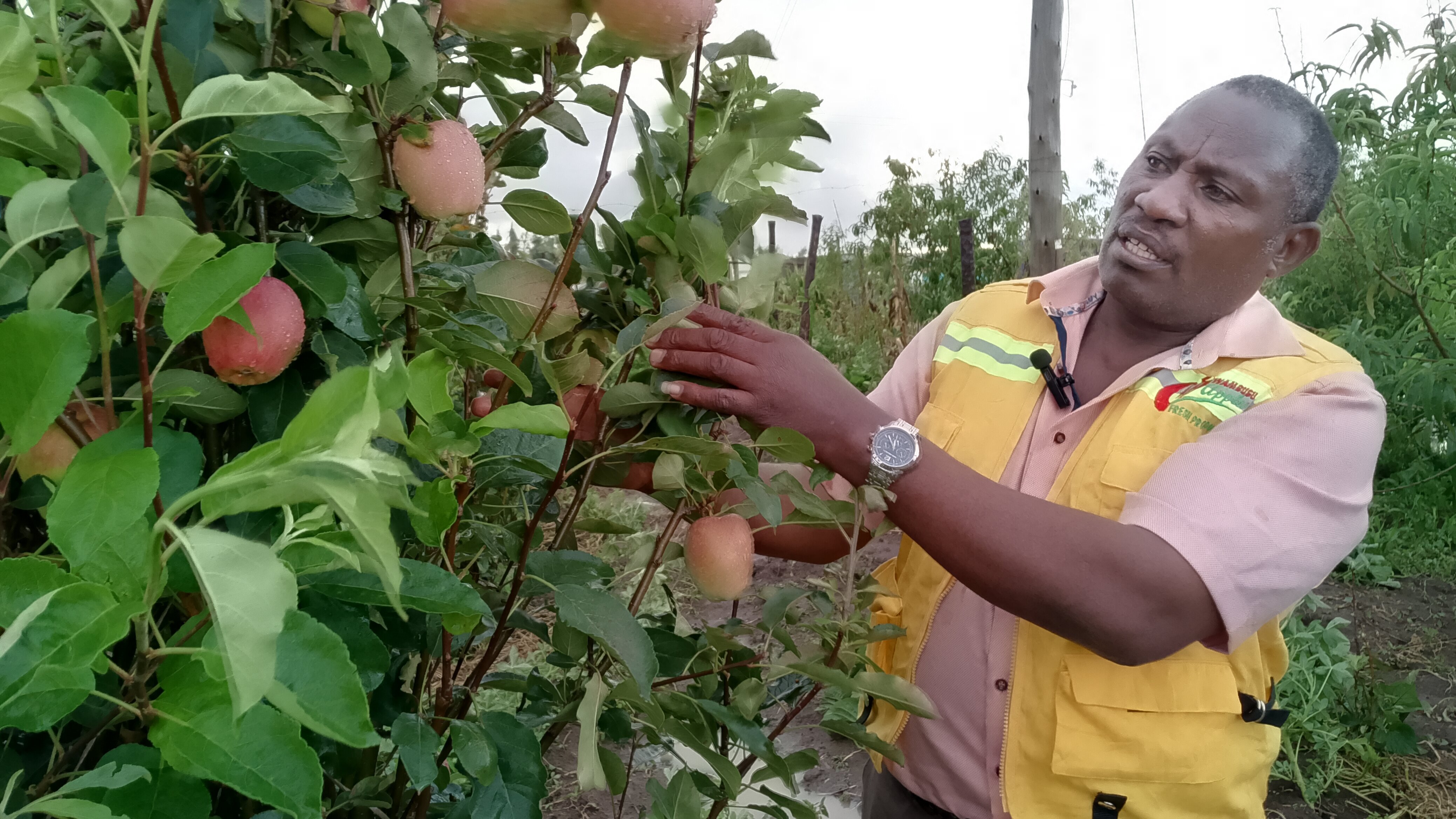
Mr Peter Wambugu, the owner of Wambugu Apples company checking on his farm at Ngobit Ward in Laikipia East Sub-County. Photo/James Murimi
When Peter Wambugu stumbled on some wild apples at the nearby Aberdare Forest in Tetu within Nyeri County in 1985, little did he know that he would one time be minting millions of shillings from apple farming.
The then 29-year-old then introduced the seedlings in his small rural farm and grafted them with other hybrid varieties.
The turn-around of Mr Wambugu’s life started here whereby his fruits attracted demand from other Kenyans who were keen to buy and learn on this new variety of apple.
His current brand christened Wambugu Apples, was born after the fruits were tested and certified by the Kenya Agricultural and Livestock Research Organisation (Kalro).
His apples have an elongated oval shape unlike the normal ones which are round.
‘Wambugu Apples’ is now a fully-fledged grower and exporter company.
It was at this point that he resolved to venture into large-scale farming of apples, hence, purchased 23 acres of land at Ngobit ward in Laikipia East Sub-County.
Mr Wambugu works alongside his wife and two children, working round-the-clock to satisfy the huge growing demand for Wambugu Apples.
His fruits have attracted demand in the US, Africa, Europe, and the Middle East.
The 68-year-old farmer sells his seedlings at Sh1,000 and his major market is in Zimbabwe, Botswana, Mozambique and locally. A piece of apple goes for Sh100.
“This is a fruit that was introduced into the country by the white settlers. My wife and I decided to purchase this land so that we could expand the apple farming venture. I bought for my two children four acre-pieces of land each so that they continue expanding the Wambugu Apple brand. We are doing this business as a family,” Mr Wambugu says.
The farmer uses a mixture of Aloe vera, pepper and marigold to manufacture chemicals to prevent pests from destroying his fruits.
“I want to tell my fellow Kenyans that there is money in apple farming. Parents should also encourage their children to venture into the practice. For instance, some investors from Dubai want me to supply them with three containers of products while others in America are keen on purchasing two million containers of the same,” he says.
“To be realistic, Wambugu together with his family cannot fully satisfy that huge market. That is why I am urging other farmers to diversify and embrace apple farming. By venturing into this practice, we can reduce unemployment in the country,” he adds.
He says the fruit matures within six months after planting.
The farmer has sunk boreholes and dug water pans to ensure that there is enough supply of water for the fruits.
Moving forward, he wants to start value-adding his fruits by processing juice for both local and international markets.
Mr Wambugu is also planning to purchase an additional 1,000 acres of land to plant more apples, in his bid to satisfy the growing demand of the fruits.
In January this year, Wambugu Apples introduced a modern fruit grading and packing warehouse at Infinity Industrial Park in Nairobi.
The new facility operates a capacity of between 10 to 15 tonnes per hour so as to meet the demand of the fruit.
It has the capacity to grade and pack a range of fruits including avocados, mangoes, passion fruit, peaches, pears, apricots, and tomatoes.
Mr Wambugu’s daughter – Kate Wambugu – said then: “We have many apple farmers, though having favourable climate conditions to grow apples and realise good harvests, have been having challenges on where to take their produce. With this machine, we are now entering a new chapter of grading the fruits with precision to suit local and international markets”.
Kenya Apple Growers and Exporters Association (KAGEA) chairman Matthew Njenga says the ultra-modern warehouse will also help in conserving the environment and help farmers get value for their produce.
“We want to go beyond mere grading. Wambugu Apples aims to become a hub for value addition, exploring opportunities to process and package fruit-based products,” Mr Njenga tells AVDelta News.