
Organic Fields founder talks about clean markets, quality organic fertiliser
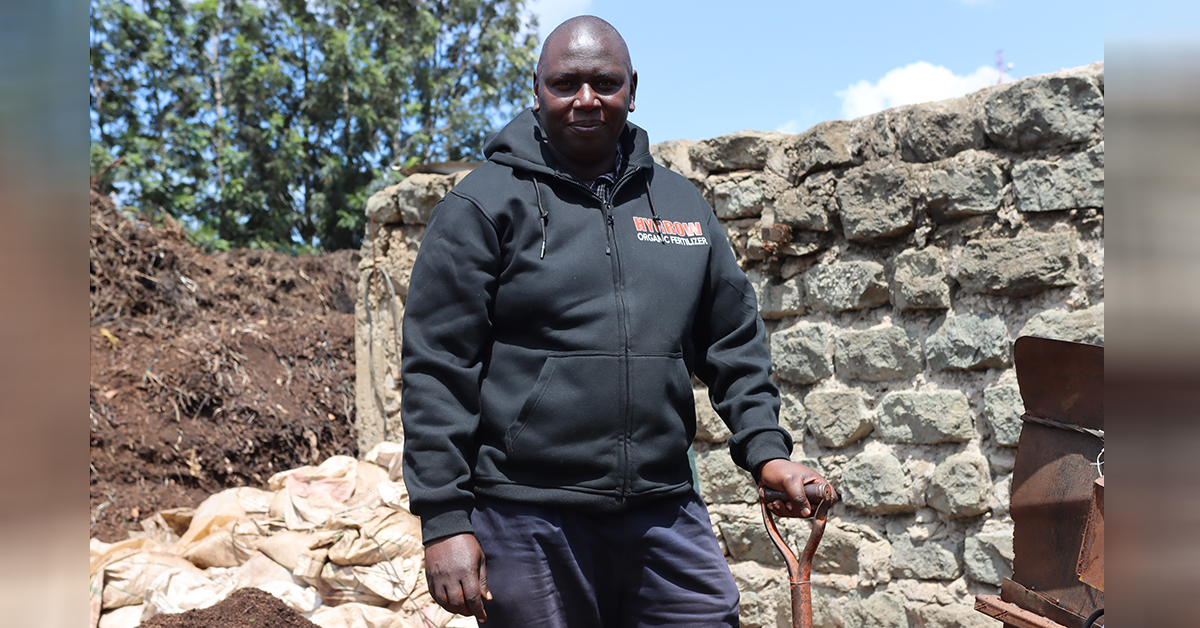
Mr Richard Mwangi, founder of Organic Fields in Ruiru, Kiambu County. Photo/AVDelta News
In 2018, Richard Mwangi founded Organic Fields, an organisation specialised in composting of Market Waste to fertiliser.
The organisation generates its revenue from the sale of the organic fertilisers in the market.
The waste is collected from Githurai Market and thereafter the composted waste is sorted, sieved and mixed with other ingredients to produce a high-quality organic fertiliser with a high pH for soil conditioning and nutrients release.
Currently, Organic Fields has over 60 employees, with their clients ranging from smallholder farmers, urban gardeners, nursery plant raisers and landscapers.
What inspired you to venture into this space?
The need to have clean markets free of bad smell and recycle the nutrients back to the farms to support the next crop cycle was the biggest motivation. The need to support organic farmers with quality inputs so that they can consistently produce and serve the growing market, The need to provide alternative product to the chemical fertilisers that are locally produced and create employment for youths, these were the inspirations.
What is the process of generating this organic fertiliser?
The organic fertiliser is generated through composting food waste from urban markets, The waste is aggregated by the waste aggregator, collected, sorted and composted through a controlled system to achieve a high-grade compost. The compost is then screened, sieved and mixed with biochar, bone meal and stone and granulated to produce a high-quality organic fertiliser known as Hygrow Organic Fertiliser
In December 2021, Organic Fields received a Sh5 million grant from the USDAF and Stanbic Foundation. How has this funding impacted your operations?
Before the grant the operations were quite small in our operations and also our market reach was quite small. We had challenges training farmers, conducting demonstrations and collecting enough waste for the composting process. Our overall output capacity was really very small. Currently, we have around 60 employees.
The grant enabled us to acquire new machinery, which enabled us to increase the processing capacity from 80 bags of fertiliser a day to 500 bags of fertiliser daily.
The company has also gone above and beyond to train 30,000 farmers on the benefits and use of the organic fertiliser in a number of counties, including Kiambu, Murang'a, Nyeri, Makueni, Kirinyaga, Embu, Meru, Tharaka Nithi, Laikipia, Nyandarua, Machakos, Kitui, Nakuru, Kericho, Bungoma and Kajiado. In fact we plan to supply over 50,000 smallholder farmers this year.
How did you learn about the grant and how was the application process?
I learned about the grant through the newspapers and also social media platforms and thought it would be a great try. I was quite hesitant to apply because I had not done such a proposal before then. But almost all questions were addressing my company needs and though didn’t know anyone there, I gave the benefit of doubt. The application process was easy and straightforward. Simple English. The business pitching was quite a nervous experience, but then, I was talking of my company and products and I knew them better and marketing them was not hard either.
What are your future projections especially after receiving this grant?
Our future plan is to replicate the model in other towns like Nakuru, Eldoret, Mombasa, Bungoma, and Meru to be able to convert the huge tonnage of waste generated and recycle it back to the farms. We plan to expand to Uganda this year as we have customers who have expressed interest in our fertiliser there.