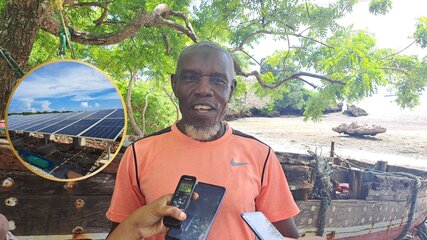

How solar mini grid is transforming lives of over 600 households on Mkwiro island
- Created by Mishi Gongo
- Society
The solar mini grid has breathed new life into Mkwiro and its neighbouring Wasini Island, both of which had never seen electricity since Kenya’s independence.
It has been almost a year since solar power arrived on Mkwiro Island in Kwale County, bringing a new wave of hope and progress to the community.
Once completely off the grid, this remote fishing village now thrives under the hum of solar-powered electricity.
The installation of a solar mini grid has breathed new life into Mkwiro and its neighbouring Wasini Island, both of which had never seen electricity since Kenya’s independence.
With solar energy now available, the economic and social fabric of the community has been transformed in ways that are not only visible but tangible.
It is a Thursday morning, Mkwiro Island buzzed with activity as people went about their daily routines.
The promise of a brighter future was evident in the faces of the locals, particularly in the home of Ms Mwanamkuu Bakari, a 43-year-old mother of four(4).
Ms Bakari’s eyes gleamed as she flipped through the channels on her television, watching President William Ruto’s state of the nation address.
“At last, we feel like part of the Kenyan citizens,” she said, her smile wide with pride.
Before solar power arrived, life on Mkwiro Island was difficult. Without electricity, locals depended on tin lamps for light, and they struggled with poor fish storage, which led to significant economic losses.
The main source of income for the islanders,fishing was severely hampered by the lack of refrigeration, causing many fishermen to sell their catch at throwaway prices to avoid spoilage.
Ms. Bakari recalled the hardships: “We used to listen to radio, but charging the radio receivers or buying batteries was too expensive. We had to cross to Shimoni just to charge our radios and phones, which was tiring and costly,” she explained.
Ms Bakari’s household was not just without lights, it was without a reliable source of energy.
“I used to spend Sh70 on paraffin every day, but it was never enough to power everything. We had to put out the lamps after 8pm, and this really hindered my children from studying,” she said, adding that her household’s daily expenses were a burden.
In addition to fishing, Ms Bakari also farmed seaweed.
“The cost of living was unbearable,” she said, shaking her head.
“But now, with solar power, I only buy a Sh50 token, and it lasts for a week.”
The financial relief has allowed her to invest in a chama (a local savings group), giving her hope for the future.
“Before, everything was a struggle,” she added. But now, life has changed.
The solar power has also opened up new opportunities for women on the island. Many are now making fresh juices and ice, small businesses that did not exist before.
“Women were mostly involved in seaweed farming, which has low returns, and octopus fishing, which is hard because many fishermen now use gas cylinders, making it difficult to find octopuses near the shore.The solar power has created jobs for us, and it has empowered us,"Ms. Bakari explained.
Ms Bakari is not the only one to benefit from the solar mini grid.
Mr Mkandi Fadhili, a local entrepreneur who cuts building blocks, has seen his business flourish.
“Before, I used diesel worth Sh 3,000 to power my grinder. Now, I use an electric grinder, and the work is faster and easier,” Mr Fadhili said.
The improved productivity has allowed him to make more money, and he is now able to comfortably take care of his family.
“The solar power has made my business more efficient, and I am grateful for this opportunity,” Mr. Fadhili added.
The local village elder, Mzee Mwalola Hemedi, shared similar sentiments.
“The electricity has opened up the village in ways we never imagined,” Mzee Hemedi said.
“Before, we would take our fish to Shimoni for preservation, or we would sell them at throwaway prices. But now, we have freezers, and we can preserve our catch longer."
The arrival of solar power has eliminated the need for long journeys to Shimoni and reduced the losses that fishermen once faced due to spoilage.
“The freezers have really helped us,” the elder added.
The solar mini grid is part of a larger, multi-million-dollar project funded by the World Bank, in collaboration with the National Government through the Rural Electrification and Renewable Energy Corporation (REREC).
This initiative is part of the Kenya Electricity Modernisation Project (KEMP), aimed at improving energy access in rural areas.
The $10 million solar mini-grid project will develop seven grids in Kwale County, ultimately benefiting approximately 3,000 people in Mkwiro and Wasini Islands.
The solar power initiative has sparked a transformation in the community, particularly in the fish processing sector.
With refrigeration and more efficient tools, fishers are able to preserve their catch, increasing the market value of their products.
Before the installation of the solar mini-grid, Wasini and Mkwiro Islands had faced severe challenges.
Operational and maintenance officer at Wasini/Mkwiro solar mini grid Alex Thungi says the station produces 731 kilowatts and serves at least 600 customers.
Mr Thungi says some areas have not been reached, but they are working to ensure each and every part of the two(2) islands have access to electricity.
"We have not reached the BMU at Mkwiro, but hope to reach soon so that fishermen can have enough light when the venture into the sea at night," he said.
He added that the station has 1,820 operational solar panels.
The success of the solar power project on Mkwiro and Wasini Islands is a model of how renewable energy can spark socio-economic transformation in rural Kenya.
With solar power, Mkwiro Island is no longer in the dark. It is now a beacon of progress and hope for the entire region.