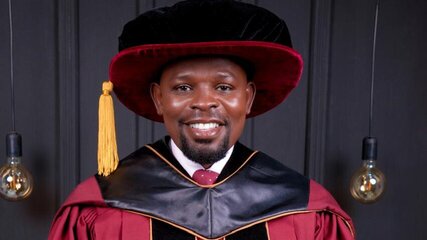

How TVET propelled Dr Leonard Ouma to become an academic giant
- Created by James Murimi
- Profiles
Dr Leonard Ouma was born from a humble family with low key economic capabilities in the remote village of Kitawa, Homa Bay County.
If courage, resilience, inspiration and optimism were a person, then Dr Leonard Ouma Mrongo would be an ideal epitome for passing persistence tests and navigating life challenges to create a desired future.
Dr Ouma took us down his royal journey to success and from grass to grace, when AVDelta News team met him during his graduation at Kenya Methodist University (KeMU) on October 19, 2024.
“I never expected I would be where I am today, but always wanted to do the best wherever I was. I thank God that His grace from above provided me these opportunities,” Dr Ouma said.
Dr Ouma was born from a humble family with low key economic capabilities in the remote village of Kitawa, Suba South sub-county, Homa Bay County.
His academic journey began at Kitawa Primary school where he excelled in his Kenya Certificate of Primary Education (KCPE) examinations and secured an admission at the prestigious Kanga Boys High School in South Nyanza.
However, he was forced to forfeit the chance due to lack of school fees and resorted to join Ranen SDA Secondary School in Migori where his elder brother served as a pastor.
His hopes to secure a position at a public university through the government-sponsored programs were diminished in 2000 after he missed the cut-off points narrowly, by a point, in his Kenya Certificate of Secondary Education (KCSE) examinations results.
Ordinarily, in the lakeside, when bright students from a poor background miss the direct entry to university, they are left with no option but to join fishing activities so as to sustain their livelihoods.
Students who take different pathways by joining Technical and Vocational Education Training (TVET) institutions are regarded as failures or clueless.
But Dr Ouma opted to join Kisumu National Polytechnic where he pursued a Diploma in Civil Engineering.
Upon graduation, he secured a job with private firms where he practiced alongside other experienced engineers and constructors who helped to boost his aspiration of being the best in the engineering field.
He was later employed by the then Ministry of Roads in 2008 as a roads officer.
He was later employed by Kenya Rural Roads Authority (KeRRA), a parastatal within the Ministry of Roads and Transport where he works to date.
During the inception of devolution in Kenya, he tried his hands in politics where he declared his interest to the public to contest for the Member of County Assembly (MCA) seat in Gwassi North ward located in Suba South constituency, Homa Bay County.
During the campaign trails, he claims that his key opponent, who was also a trained civil engineer, poked holes into his academic competence.
Dr Ouma says his nemesis claimed that him (Dr Ouma), then, was 'a mere Diploma certificate holder from a polytechnic’. His opponent had graduated from the prestigious University of Nairobi (UoN).
This assertion did not sit well with his family members who later prevailed on him to drop his political bid.
On the other hand, that rude challenge compelled him to register for Bachelor of Purchasing and Supplies Management course before he again registered for a Bachelor of Civil Engineering course both at Jomo Kenyatta University of Agriculture and Technology (JKUAT).
His quest for education was never exhausted even after excelling and graduating with two Bachelor's Degrees. He registered for Masters of Science in Project Management at JKUAT.
Afterwards, he pursued a PhD course in Business Administration and Management (Strategic Management Option) where he recently graduated with a prestigious academic honor at the Kenya Methodist University (KeMU).
Unbowed, Dr Ouma is currently a student for Master's of Science in Civil Engineering, signaling that he will later register for Bachelor of Law so that he can represent the marginalized and destitute people in the corridors of justice.
Dr Ouma reflects back and narrates how his academic journey was marred with uncertainty and financial struggles, appealing to youths to embrace quotes of America’s 30th President Calvin Coolidge: “Nothing can beat the place of persistence. Talent will not; nothing is more common than unsuccessful men with talent. Genius will not; unrewarded genius is almost a proverb. Education will not; the world is full of educated derelicts. Persistence and determination are omnipotent”.
“Owing to the TVET institutions emphasis on hands-on and real-life skills to their learners, they stand a better chance to help shape and the realization of the developing countries economic demands,” Dr Ouma said.
He was saddened that TVETS were still largely underestimated in Kenya and Africa and that the direct entry to university has continued to scoop up the minds of students and parents.
He is convinced that such a technical course would also go a long way in solving the prevalent and growing joblessness among several graduates that are churned out of universities every year.
“I am a testament that one can choose to go through TVET institutions and still rise to the apex of academic levels. It does not matter whether a student chooses to go through a technical training institution or direct to university since the end will always justify the means,” Dr Ouma said.
Dr Ouma also called on the Kenyan government and other African nations to begin focusing heavily on climate smart ventures as the world approaches several climate tipping points.
His assertion comes against the backdrop of President William Ruto’s several emphasis on the need of parents to convince their children to register for technical courses in the TVETs across the country.
“We resolved that we needed a different assessment tool for our TVET institutions. Many students used to fail exams in TVET institutions because they are poor in English language. For instance, when you are a mason, you don’t need to be perfect in English. If education is the key, then TVET is the master key,” President Ruto said at the Nyeri National Polytechnic where he lit the flame to mark 100 years since the inception of TVET institutions in the country early this year.
Dr Ouma prides himself in establishing the Mkenya Education Fund Foundation that has so far supported at least 110 students through high school, tertiary colleges, and universities through bursaries, to a tune of Sh2.5 million.
During the recent graduation ceremony, KeMU Chancellor Prof Kobia Ataya called on the graduates to embrace adaptability in all spheres of life.
Prof Ataya maintained that adaptability was vital to help them when they encounter challenges and opportunities, and to embrace change with resilience.
“Remember, it is not the challenges you face that define you, but how you choose to respond to them and lifelong learning as a catalyst for societal transformation. The quality education you have received equips you to become agents of societal transformation. You have acquired critical thinking skills to enable creativity, innovation and ability to collaborate in the pursuit of solutions to problems and transformation of the society around you,” said Prof Ataya.