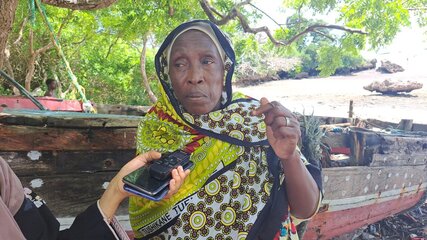

Mkwiro: A village free of gender-based violence
- Created by Mishi Gongo
- Society
Children are taught about religion, personal responsibility, respect for others, and conflict resolution.
Mkwiro, a small village nestled on an island off the coast of Shimoni, Kwale County, is a place where peace reigns and gender-based violence (GBV) is a rare phenomenon if not strange.
To reach this peaceful haven, one must cross the vast ocean from Shimoni, a boat ride that takes about half an hour. But what awaits on the other side is a community unlike many others in the region,a village with a unique culture, where gender-based violence has never been reported.
As we step off the boat and walk towards the beach, the first thing that strikes us is the sight of children playing freely along the shore.
Their laughter fills the air, and their carefree energy radiates. Children as young as five years old can be seen walking along the beach with small fish catches in hand, their innocence untouched by the dangers that plague many other parts of the world.
It is here that we meet village chairman Mwalola Hemedi with Mkandi Fadhili, and Mwanamkuu Bakari who are locals and have agreed to take us on a tour of Mkwiro and share their experiences of living in such an unusually peaceful community.
"We live here as brothers and sisters," says Mwanamkuu with a warm smile, greeting yet another local who is sitting on her balcony. "We help each other in everything. We do not fight; we support each other."
Her words reflect a deep sense of unity and solidarity that seems to define Mkwiro.
In a time when many villages across the country are grappling with rising cases of gender-based violence, Mkwiro stands as an anomaly,proof that community values and good morals can foster a safe and harmonious environment.
On the day of our visit, the weather is rainy, with heavy clouds casting a grey blanket over the island.
The villagers, however, are not deterred. They have gathered tens of large jerricans and water tanks, filling them with the rainwater, as it is their only source of water.
Mr Hemedi--the village chairman who has lived in Mkwiro for most of his life--speaks with pride about the values that have shaped the community.
"We have never recorded any case of GBV or serious crime here.The root of peace in our village is good morals. We teach our young children to respect one another, to help each other, and to resolve conflicts without resorting to violence," says Mr Hemedi, his voice steady and confident.
Adding that the only animal they use a knife on is a chicken.
"Even slaughtering a chicken we only do it because it is a source of food. Here the only attacks we get are from snakes which are not many also," he said.
The values instilled in Mkwiro’s children from a young age are crucial to maintaining the atmosphere of peace. One of the village’s core practices is the mandatory attendance of madrassas, where children are taught not only about religion but also about personal responsibility, respect for others, and conflict resolution.
According to the villagers, these lessons play a significant role in preventing the cycle of violence that often plagues other parts of the country.
The Chairman explained that every child in Mkwiro knows that if they misbehave, any adult can step in and correct them.
"It is not seen as interference; it is seen as guidance. That is why, even when they grow up, they know how to relate with their partners peacefully and resolve conflicts in a non-violent way,"he said.
This emphasis on early intervention and positive discipline is part of a broader cultural shift in Mkwiro, one that values cooperation, understanding, and mutual respect. It is a far cry from the toxic gender norms and patriarchal values that often fuel violence in other communities.
Mkwiro has a population of about 3,000 people, and the tight-knit nature of the community is evident.
Despite its small size, the village has managed to foster an environment in which both men and women feel safe and valued.
Mwanamkuu, who has lived in Mkwiro for about 40 years, attributes much of the village’s success in preventing GBV to the strong foundation of marital teachings.
"Before getting married, both men and women are taken through marital teachings.This ensures that when they enter into marriage, they understand the roles and responsibilities they have towards one another. There is no place for violence in our marriages ," Mwanamkuu explains.
She points to the fact that these teachings are not limited to women but are also extended to men, ensuring that both genders are equipped with the tools to build healthy and respectful relationships.
In Mwanamkuu’s view, this focus on education before marriage is one of the key factors that has helped Mkwiro maintain its peace.
She believes that many cases of GBV in other regions are a result of young people entering relationships without understanding the dynamics of marriage or how to communicate and resolve issues effectively.
"In the past, adolescents used to undergo initiation ceremonies where they were entrusted to elders to teach them about the ways of life. This was a way to ensure that they were properly prepared for adult responsibilities. Unfortunately, this practice is becoming less common, and many young people are not receiving the guidance they need before settling down," she says.
Unlike other regions where violence has become ingrained in the social fabric, Mkwiro continues to prioritize education, community involvement, and mutual respect as the foundation of its way of life.