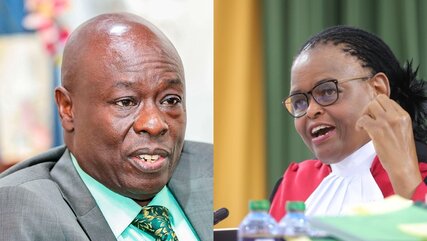

Supreme Court clears way for next legal fight in Gachagua case
- Created by Juma Namlola
- Top News
The apex court ruled that it lacks jurisdiction to stop cases pending before the High Court.
The Supreme Court’s decision on Rigathi Gachagua has settled a procedural question, but opened the door to a longer legal fight.
In a ruling delivered on Friday, the Supreme Court declined to halt proceedings related to the impeachment of the former Deputy President, sending the politically charged dispute back to the High Court.
The apex court ruled that it lacks jurisdiction to stop cases pending before the High Court, clarifying that its powers to issue stay orders apply only to matters before the Court of Appeal.
The decision dealt a blow to attempts by both Mr Gachagua and the National Assembly to short-circuit ongoing litigation.
Chief Justice Martha Koome, leading the five-judge bench, made it clear that the court was not determining the legality of the impeachment itself.
Instead, the judges confined themselves to procedural issues surrounding how the High Court bench hearing the case was constituted.
“This court cannot exercise jurisdiction where none exists,” the judges ruled, declining to interfere with proceedings already before the High Court.
For Mr Gachagua, the ruling means the impeachment remains in force, at least for now. His bid to stop the High Court from hearing consolidated petitions challenging the process failed, leaving his legal fate firmly in the hands of the lower court.
At the same time, the Supreme Court rejected the National Assembly’s attempt to strike out Mr Gachagua’s cross-appeal. This means both sides remain in the fight, with their arguments set to be tested before the High Court bench.
Mr Gachagua was impeached by Parliament in October 2024, triggering a flurry of court challenges questioning the conduct of the National Assembly, the Senate process, and the constitution of the High Court bench assigned to hear the matter.
Since then, the case has become a litmus test for the balance of power between Parliament and the Judiciary, as well as the limits of political accountability under the Constitution.
Supporters of the impeachment argue that Parliament acted within its mandate, while Mr Gachagua’s allies maintain that the process was flawed and politically motivated.
With the Supreme Court now stepping aside, attention shifts squarely to the High Court, where substantive questions surrounding the impeachment will be heard.
The outcome could have far-reaching implications for future impeachments, judicial oversight of Parliament, and the political careers of those involved.
For now, the Supreme Court has drawn a clear line: it will not short-circuit lower courts — even in cases carrying heavy political consequences.