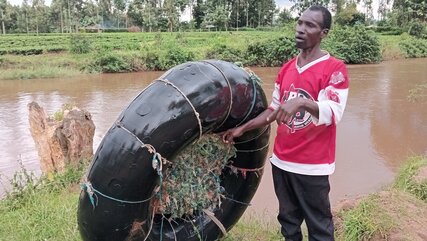

Second-hand tube comes in handy in ferrying locals across a swollen river
- Created by Jeremiah Choge
- Society
Effort Sowoi with his friend Samuel Kibet use second-hand tube to ferry the community across swollen River Yala in Nandi County.
We find Samuel Kibet and Effort Sowoi at 6am enduring a chilly morning, walking through lush tea plantations down to the river.
The duo have dared to enable communication and connection between Kiprambu and Taunet villages by ferrying residents along the river.
The Yala River smoothly meanders through Kimondi forest and dissects villages through expansive Nandi forest in Chesumei, Nandi County.
Its red-dirty water falls thunderously at the cliffs and whistles would be heard where the water negotiates with the reeds at the edges.
Some residents claim the river swells during the heavy rainy seasons and the 'whistles of death' are so rampant.
Many lose their lives when they drown into Yala River.
At least two(2) or three(3) persons including school going children have died by accidentally drowning into the deepest sections of the river annually.
The duo have unpacked a huge tube and painstakingly inflated it by blowing with their mouth, and quickly closed the valve with the lid to prevent deflation.
They start ferrying locals across the swollen River.
"This is just a second-hand tube which I bought purposely for transportation. It has served for years as a mobile bridge or a makeshift boat for the locals," Mr Kibet told AVDelta News.
As the residents pursue their daily economic errands, Mr Kibet, who lives about 100 metres from the river bank, has been always available when needed.
For years, transportation infrastructure has been a problem to the locals across the villages and accessing markets for their agricultural commodities.
They are forced to use long and costly routes.
Not even the motorbikes, which are the modern last-mile means of transportation, have been of any help to them to cross a 40-metre-width Yala River.
"Tracks ferrying sugar canes and tea cannot access some areas along the river and locals have to transport the produce to the collection points that are located five(5) kilometres away. And we only enable children and adults to cross the river," narrated Mr Kibet.
The man-made bridges would not apply in the wide river and the floaters have come in handy in transportation of the learners for Mumbor, Taunet, and Chepsonoi primary and junior secondary schools.
Mr Kibet and Mr Sowoi do not charge students to cross the river.
They said that they have volunteered to offer support to the community and protect the children who form the larger statistics of those who have perished in the Yala River.
According to the residents, over 20 people have died by drowning into River Yala between 2010 and 2021 and thus due to such tragic accidents, the locals have devised their own mitigation measures.
Mr Sowoi said that they charge Sh10 per head though in many cases they are forced to ferry the majority of the villagers for free.
"We can make up to Sh300 per day from those who would afford to pay. It's just a small fee and we largely play a critical role in protecting lives and enabling swift transportation across the villages," he said.
The duo said that even in the middle of the night, they are called to attend to emergency cases including ferrying sick persons.
They are not only the drivers of the floaters, but also skilled in diving and the residents surrendered their lives on their hands through the raging waters.
“For over 20 years, I have been living along the river and had to learn diving skills to handle emergency incidents,” said Mr Sowoi.
Mr Sowoi said that the county government promised to put a bridge to enhance transportation between the two(2) villages, but the promise is yet to be fulfilled.
Before that is done, the residents will continue trusting the duo's innovation.
“It is a matter of life and death floating a loaded tube and countering water currents across the river. We have to use a lot of energy propelling the floater from one side to the other, thanks to the trust and confidence people have in us,” said Mr Sowoi.