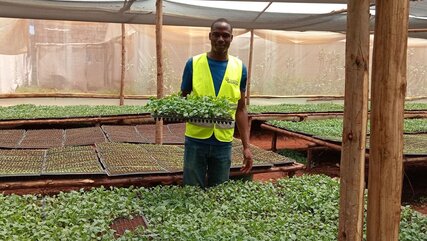

For Kelvin Tanui, fortune is in tree and vegetable seedlings production
- Created by Jeremiah Choge
- Agriculture
He started with simple farming technique, but to maintain clients, he sought for more knowledge from established seedlings vendors.
When he sat for Kenya Certificate for Secondary Education (KCSE) examination, Kelvin Tanui was hopeful of proceeding with his tertiary education to pursue his dreams.
However, lack of school fees hindered him from achieving his academic dreams.
He had no option, but to venture into menial jobs to support his siblings and extended family.
He once thought of trying his hands in farming though his parents' land was not enough and thus leased a small parcel of farm to grow trees and vegetable seedlings for sale.
It was just a simple farming technique that would enable Mr Tanui to produce thousands of seedlings and sell them to the readily available market in his home at Ndalat village in Nandi County.
But the demand for a variety of seedlings went high and to maintain his clients, he sought for more knowledge from established seedlings vendors in Central parts of Kenya.
Mr Tanui's interaction with the seedling farmers motivated him to start his own farm and this has paid off big time as he is currently running a project worth over Sh5 million greenhouses.
"I met a farmer in Kenol in Murang’a where I used to buy his seedlings, and I spent only three(3) days in his greenhouse where I learned the new techniques of growing seedlings before I returned back home to launch my project," he told AVDelta News in an interview.
First, he had to look for start-up money after selling maize and borrowed some from friends to lease land to put up a greenhouse structure.
Among the building materials he acquired include poles, polythene covers, seedling grades, hosepipes, water tank, media soils and vegetable seeds.
“I completed the first phase in 2023 and incurred a cost of Sh250,000. It produced over 25,000 seedlings and currently produces up to 200,000 seedlings per month, and every single seedling is sold at Sh2,” said Mr Tanui.
Mr Tanui,26, initially had a dream of proceeding with his education to be a teacher, but farming has become so engaging and fully sustaining that he has opted it to be his main source of income.
When this writer toured the farm, it was full of activities as four(4) workers were busy, some were filling the grades with soils and others were irrigating seedlings.
Among the seedlings set in rows and fixed in plastic cages include cabbages, kales, tomatoes, red pepper, beetroots among others.
The customers were waiting to be served their desired seedlings that had matured for transplantation, and Mr Tanui was sorting out healthy plants.
He was in charge of counting and packaging the seedlings ready to be delivered to the farmers who made their orders.
“It was a simple initiative at the beginning and after making some expansion to meet market demand, I had to employ workers and some weeks I had up to 12 laborers for fast and effective execution of tasks,” he explained.
For efficient supply of water and filling the cages demand more workforce, Tanui said that he had to train his regular farm handlers on technical handling of the seedlings, chemical application and soil testing procedures.
According to the farmer, the seedlings are fragile and need close management including frequent checking of the soil acidity that is most affected by chemicals used to control pesticides and fungal diseases.
“Before applying chemicals including fungicides and pesticide, the prescribed amount of water can be used for dilution but on the germinated seedlings with the utmost two tender leaves stage requires low Ph, and electronic Ph meter is used to make adjustments between 6-7pH,” he explained.
He added that more acidic chemicals negatively affect the growth and development of the seedlings.
"The quality of the soils should be light and aerated. The compost soils are locally formulated media consisting of nutrients to support the rapid growth of the seedlings," he explained.
Mr Tanui demonstrated that the soils should be free from diseases and basic pH and diseases and pests are rarely witnessed in the seedbeds within the greenhouse.
“The pesticide and fungicide should be occasionally applied, but sparingly. The greenhouse should be kept clean and weed out unnecessary plants that can breed pests and diseases at the floor,” he stated.
He said there should also be a well installed water irrigation system for sufficient supply of water.
Mr Tanui said that the reservoir tank helps to store water, and hand water sprinkling is more applicable for meticulous irrigation of the plants in the cages.
“Seedlings need a constant supply of water depending on the weather condition at a given time. During rainy and cold seasons, irrigation can be done once a day and twice during dry season,” he explained.
He said the seedlings take up to three(3) weeks to mature and in the fourth week, they are subjected to hardening-off to enhance their survivability after being transplanted.
The application of water is gradually reduced shortly before being packaged for sale.
Every month, Mr Tanui, who is commonly known as Young Farmer, said that he earns between Sh80,000 to Sh100,000 from the seedlings he produces monthly.
It is now about 16 months since Mr Tanui ventured into the seedling production industry and greenhouses occupying a third of his farm which has become his major source of income.
He said the initiative has supported his family and afforded school fees for his siblings in high school and university.