

Kenya’s corruption fight stalled, warns Transparency International
Kenya’s battle against corruption has ground into a familiar, troubling rhythm: bold promises, high-profile arrests, televised outrage--and then silence.
The latest 2025 Corruption Perceptions Index (CPI) by Transparency International suggests that beneath the headlines and political declarations, little has fundamentally changed. Kenya scored 30 out of 100, dropping two points from 2025 and remaining firmly below the global average of 42. The score places the country among 45 Sub-Saharan African nations that scored below 50--the threshold Transparency International considers a sign of serious corruption challenges.
For many Kenyans, the numbers reflect lived reality.
Public hospitals struggle without essential supplies while budget allocations balloon. Roads are launched with fanfare but stall midway. Procurement scandals surface with mechanical regularity, often involving billions of shillings, yet convictions remain rare. Anti-corruption raids make prime-time news, but court cases drag on for years, thinning into withdrawals, technicalities, or acquittals.
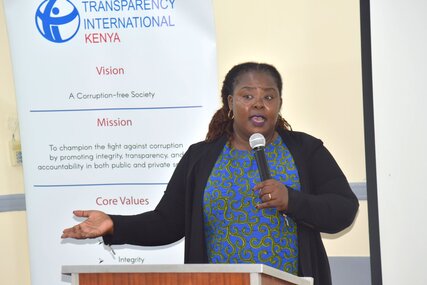
Transparency International Kenya Executive Director Sheila Masinde said in Nairobi on Wednesday the country’s latest score signals something deeper than isolated scandals.
“Kenya’s latest score indicates that corruption is no longer a series of isolated incidents; it has evolved into a sophisticated, resilient system that has permeated all levels of society and government,” she said.
According to the report, weakened enforcement of anti-corruption laws, gaps in implementing Chapter Six of the Constitution on leadership and integrity, and what TI describes as a disturbing pattern of withdrawn or weakly prosecuted cases have entrenched impunity.
“With few high-profile convictions secured for corruption cases, coupled with the disturbing pattern of withdrawal of cases witnessed in Kenya and weak prosecution, many offenders have escaped punishment thus perpetuating impunity,” Masinde added.
Over the past 13 years, Kenya’s CPI score has oscillated between 25 and 33--a statistical flatline that underscores stagnation despite new institutions, revised laws and repeated reform pledges.
Kenya’s decline mirrors a broader regional crisis. Sub-Saharan Africa remains the lowest-performing region globally, with an average score of 32 out of 100. Only four of the 49 countries assessed--Seychelles (68), Cabo Verde (62), Botswana (58) and Rwanda (58)--scored above 50.
At the bottom of the ranking are Somalia (9), South Sudan (9), Eritrea (13) and Sudan (14), illustrating the sharp governance divides across the continent.
Ten countries in the region have significantly worsened since 2012, while only seven have improved.
The report argues that corruption in the management of public funds reflects a deeper problem: a lack of political integrity and insufficient accountability at the highest levels of leadership.
The warning signs are not confined to Africa. The 2025 CPI shows that corruption is worsening globally, with the global average score dropping to 42 — its lowest in more than a decade. More than two-thirds of countries assessed scored below 50.
Even established democracies are experiencing decline. The number of countries scoring above 80 has shrunk from 12 a decade ago to just five this year.
For the eighth consecutive year, Denmark topped the index with 89 points, followed by Finland (88) and Singapore (84).
François Valérian, Chair of the TI International Board, cautioned against viewing corruption as inevitable.
“Corruption is not inevitable. Our research and experience as a global movement fighting corruption show there is a clear blueprint for how to hold power to account for the common good,” he said, urging governments to strengthen democratic processes, independent oversight and civic freedoms.
In Kenya, the CPI score is more than a number--it is a measure of public trust.
It is reflected in stalled projects, ballooning public debt, youth unemployment, and citizens’ growing frustration with institutions meant to safeguard public resources. It is seen in courtrooms burdened with case backlogs, in whistleblowers who risk retaliation, and in oversight agencies frequently accused of political interference.
Transparency International Kenya is calling for stronger protection of civic space and media freedom, adoption of a comprehensive whistleblower protection law, tighter regulation of campaign financing ahead of the 2027 elections, and full enforcement of constitutional leadership and integrity standards.
The question, however, is not whether Kenya has laws on paper. It is whether those laws will be applied without fear or favour.
As the country edges closer to another electoral cycle, the 2025 CPI presents a stark verdict: without decisive enforcement, independent institutions and genuine political will, Kenya’s anti-corruption fight risks remaining a performance--loud in rhetoric, thin in results, and costly for its citizens.
To advertise with us, send an email to advert@avdeltanews.world