

Ruto reignites debate on academic credentials and performance in government
President William Ruto has reignited a national debate over whether academic qualifications should determine who runs government.
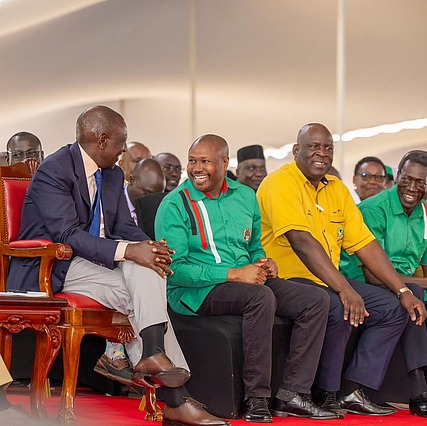
Speaking at State House, Nairobi, on Saturday, September 13, he argued that choosing a learned deputy had helped his administration deliver services.
The President said he prefers deputies with strong academic backgrounds because they do the work while the principal takes public credit.
“Ukitaka kufaulu, chagua deputy amesoma kukushinda. Wewe utakuwa unachukua credit, yeye ndiye anafanya kazi. Nilikuwa na mwingine alikuwa analakamika hajasoma. Nikaona ataniangusha.”
(If you want to succeed, choose a deputy who has studied more than you. You will take the credit while he does the work. I once had another who kept complaining he had not studied. I saw he would let me down.)
Dr Ruto has severally emphasised his academic record.
“I have studied, and I have studied well. I am probably the most learned president Kenya has ever elected.”
The deputy the President praised, Prof Kithure Kindiki, holds a PhD (University of Pretoria) and served in academia as a law lecturer and professor before joining full-time politics.
His public biographies list an LLB (Moi University), LL.M and PhD, plus professional legal training.
By contrast, Geoffrey Rigathi Gachagua, the deputy the President appeared to criticise, has a Bachelor of Arts (Political Science & Literature) from the University of Nairobi.
He later attended administrative courses, including at the Kenya School of Government.
The President’s preference for “learned” appointees has divided public opinion.
Former Cherangany MP and former Agriculture minister Kipruto Rono Kirwa has repeatedly interrogated the style and outcomes of the Ruto presidency.
He has argued that governance must be judged by results and not personal glorification.
Others on social media split along familiar lines. Those who defended Dr Ruto’s emphasis on education and expertise, say technical competence can aid policy design.
Others called the argument elitist and warned it risks sidelining grassroots leaders and aggravating political divisions.
The debate over qualifications now dovetails with accountability on manifesto promises.
The Kenya Kwanza / UDA platform pledged a Bottom-Up Economic Transformation Agenda that named small traders and informal workers (often referenced as mama mboga and boda-boda operators) among the groups to be uplifted, and included explicit teacher-recruitment targets and welfare promises.
The State House remarks landed inside a high-profile teachers’ engagement.
Teachers’ unions were led by Kenya National Union of Teachers (KBUT) Secretary General, Collins Oyuu and his Kenya Union of Post-Primary Education Teachers (KUPPET) counterpart Akelo Misori.
The leaders had gone to State House to press for concrete action on hiring, promotions, pay and classroom resources.
The teachers’ agenda included timelines for recruitment and clarity on the implementation of competency-based education (CBE).
Government figures cited in public briefings say roughly 76,000 teachers have been employed so far, against a campaign target often reported as 116,000 teachers by 2027; unions say many recruits still lack permanent terms and clear promotion paths.
Three years into the administration, teachers and civil-service stakeholders told State House they want clear timelines and verifiable milestones rather than platitudes.
The unions pressed for commitments on permanent hiring, prompt promotions, payments and resources for CBE classrooms.
For many in the teaching profession, academic titles may carry weight, but what is more important are concrete improvements: how many teachers hired, are classrooms equipped, are promotions fair, and is welfare being improved.
Photo/Courtesy
To advertise with us, send an email to advert@avdeltanews.world