

The final journey of Raila Odinga: From prison cells to freedom’s flame
The dawn has already broken over Siaya.
The air at the Jaramogi Oginga Odinga University of Science and Technology is heavy with emotion. As family, friends, and leaders gather to lay Raila Amolo Odinga to rest beside his ancestors, Kenya stands still — reflecting on the life of a man whose name is woven into the country’s long, painful struggle for democracy.
For over four decades, Raila’s life mirrored Kenya’s political evolution: full of courage, contradictions, and sacrifice. From torture chambers under Daniel arap Moi’s regime to the steps of Parliament and the corridors of continental diplomacy, Raila’s was a journey of endurance, defiance, and hope.
Born on January 7, 1945, in Maseno, Raila was the son of Kenya’s first Vice President, Jaramogi Oginga Odinga. He inherited not only his father’s name but also his defiant spirit. Educated at Maranda, then in East Germany where he studied Mechanical Engineering, Raila returned home to teach at the University of Nairobi before joining business and, eventually, politics.
His political troubles began soon after the 1982 attempted coup against President Moi. Accused of being part of the plot, Raila was arrested and detained without trial for six years — first at Kamiti Maximum Prison, then Naivasha, Manyani, and later Nyayo House, where he endured solitary confinement and torture. He was released in 1988, only to be detained again in 1989 and once more in 1990 following the death of Foreign Affairs Minister Dr Robert Ouko.
After his final release in June 1991, Raila fled the country and went into exile in Norway, fearing for his life. From there, he joined forces with Kenya’s pro-democracy movement in exile, amplifying the call to end one-party rule.
When he returned in 1992, Kenya was a nation in transition. Multiparty politics had been restored. Raila joined the Forum for the Restoration of Democracy–Kenya (FORD-K), led by his father. He later won the Lang’ata parliamentary seat in the first multiparty elections, defeating incumbent Philip Leakey of KANU.
After his father’s death in 1994, Raila’s political journey took multiple turns — from leading the National Development Party (NDP), merging with Moi’s KANU in 2001, to breaking away again to join the Rainbow Alliance that backed Mwai Kibaki’s successful 2002 bid for the presidency.
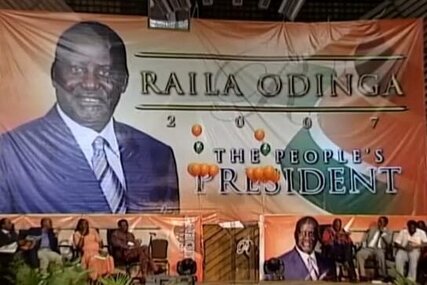
In the turbulent 2007 General Election, Raila led the Orange Democratic Movement (ODM) against President Kibaki. The disputed results sparked post-election violence that left more than 1,000 people dead. The power-sharing deal brokered by Kofi Annan made Raila Kenya’s second Prime Minister under the Grand Coalition Government of 2008–2013.
His later presidential bids — in 2013, 2017, and 2022 — all ended in controversy, protest, and court battles. Yet he remained a symbol of Kenya’s unyielding spirit of reform.
Behind the fiery speeches and defiant gestures was a man shaped by suffering and loss. His first detention cost him time with his young family. His mother died without seeing him again. He once said that Nyayo House’s dark basement “was a university of pain,” where he learned the true price of freedom.
Those close to him say that even after decades of political heartbreak, Raila never lost his humour or faith in the Kenyan dream.
And now, on this Sunday morning in Bondo, the journey is ending where it began — among the people who first called him Agwambo, Tinga, and Baba. The nation mourns not just a politician but a fighter whose scars became Kenya’s story.
As the final prayers rise at Jaramogi Oginga Odinga University of Science and Technology, one truth remains: Raila Odinga may have gone to rest, but the flame he lit — for justice, democracy, and freedom — will never die.
To advertise with us, send an email to advert@avdeltanews.world