

Varsity student held in online exam-fraud probe
As the 2025 national examination season draws near, detectives have arrested a fourth-year university student allegedly behind a sophisticated online racket offering fake national exam papers.
The operation was uncovered in a sting carried out by detectives attached to the Kenya National Examinations Council (KNEC), in coordination with the Directorate of Criminal Investigations (DCI).
The suspect, Chrispinus Nandafu Naisuma of Meru University of Science and Technology, was arrested in his hideout in Kianjai, Tigania West Sub-County.
Authorities say Mr Nandafu masterminded an online syndicate operating under the name “The Teacher’s KNEC Exam 2025”, using multiple aliases including “Dr Ibrahim”, “Madam Salim”, “Chat GPT” and “Violent Kathini Mwendwa” to dupe clients into buying counterfeit exam papers.
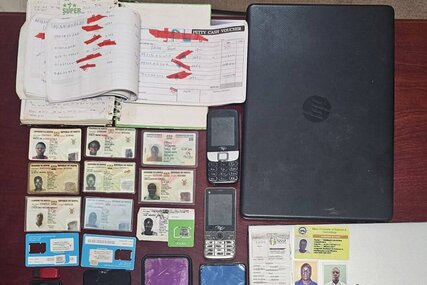
When the detectives finally moved in, they confiscated 29 Airtel SIM cards, six(6) mobile phones, two(2) laptops, and several Safaricom and Telkom SIM cards, among other items alleged to have been used in the fraud.
Nandafu is now in custody as investigations continue ahead of his court arraignment.
With the Kenya Certificate of Secondary Education (KCSE) exams scheduled to begin October 17, 2025, alongside the first exit assessments for primary and Junior Secondary known as KJSEA, authorities have intensified efforts to safeguard exam integrity.
KNEC Chief Executive Officer David Njengere outlined several security reforms being rolled out this year, 2025.
There will be personalised question papers bearing each candidate’s name, index number, and signature field to deter impersonation.
Answers are to be written directly in question booklets with detachable counterfoils collected after each session.
Another measure is pilot usage of digital smart padlocks in 250 exam‐storage containers. These smart padlocks are intended to deliver real-time monitoring of access.
“Every candidate will have a uniquely identifiable paper, and this will reduce the chances of cheating,” said Dr Njengere.
He also stressed the importance of invigilators and supervisors.
"Supervisors and invigilators are the frontline defenders of exam credibility. We count on their professionalism to safeguard the future of our learners,” he observed.
KNEC, in partnership with the Teachers Service Commission, has also committed to using only vetted teachers of high integrity to manage and supervise exams.
According to the DCI, Mr Nandafu faces possible charges including forgery, uttering false documents, impersonation, and publishing misleading material under the Computer Misuse and Cybercrimes Act.
Meanwhile, Dr Njengere has warned students against any temptations to cheat.
“Students have studied for the last four years, so I urge them to ignore those papers being circulated in various social media channels. The papers are fake," he said.
Dr Njengere also confirmed that the new directive requiring exam papers to be picked from storage containers twice daily is working well.
Kenya’s examination authorities affirm that despite recurring threats and fraud attempts, the systems put in place for 2025 aim to ensure that KCSE, KPSEA, and KJSEA exams are conducted fairly, securely, and transparently.
Parents, candidates, and schools have been urged to report suspicious offers or sale of exam materials, and to rely only on official KNEC channels for all examination information.
To advertise with us, send an email to advert@avdeltanews.world