

What awaits the new IEBC Vice Chair
- Created by Juma Namlola
- Top News
Her gender and youth might inspire a new generation, but history suggests IEBC Vice Chairs often bear the brunt of public distrust.
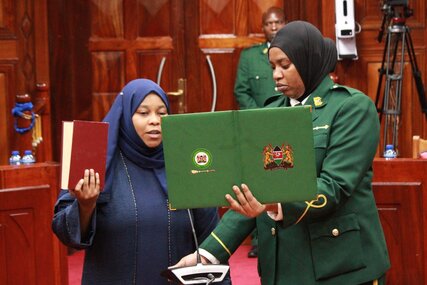
For a second time in less than a decade, a woman from the Kenya Coast has risen to the second most powerful seat in the country’s election body--the Vice Chair of the Independent Electoral and Boundaries Commission (IEBC).
Fahima Araphat Abdallah,33, takes over the role previously held by Juliana Whonge Cherera, and before her, Dr Roselyn Akombe, both of whom exited in controversy after falling out with the Commission’s leadership during turbulent elections.
As Fahima settles into her seat, she inherits not just a desk and a title, but a legacy of mistrust, internal friction, political pressure and public scrutiny that has haunted past vice chairs—and which she must now navigate with both courage and caution.
When Dr Akombe, a respected UN official, resigned in 2017 just days before the repeat presidential election, she famously said, “The commission is under siege… It has become a party to the crisis.”
She fled the country, citing threats to her life and a compromised institution.
Fast-forward to 2022, and Juliana Cherera, one of the “Cherera Four”, dramatically disowned presidential results announced by then-Chair Wafula Chebukati, calling the process “opaque.”
She too resigned amid intense public vilification, legal inquiries and political backlash.
Both women entered the Commission with high ideals and left disillusioned, raising the stakes and expectations for Fahima.
At 33, Fahima is young, visibly Muslim, and from Lamu County, a combination that makes her symbolically powerful but politically vulnerable.
Her gender and youth might inspire a new generation, but history suggests IEBC Vice Chairs often bear the brunt of public distrust, especially when elections are disputed.
She must now balance the burden of restoring faith in a deeply polarised Commission, leading under Chairperson Erastus Ethekon, while avoiding the same traps that led to her predecessors’ resignation.
Key challenges Fahima faces include:
Institutional independence vs Political influence
Like Akombe and Cherera, Fahima will have to resist subtle or overt pressure from political actors while maintaining cohesion within the Commission.
Transparency battles
The 2022 election fallout centred on questions of transparency. As Vice Chair, Fahima will be expected to champion openness—without alienating her colleagues or stepping into political minefields.
Media scrutiny and public perception
In an age of social media and fake news, any disagreement or perceived weakness can be amplified. Her identity may be weaponised by both critics and supporters.
Youthful optimism vs Veteran bureaucracy
At 33, she brings a fresh lens—but navigating entrenched bureaucratic systems and political suspicion will demand political maturity far beyond her years.
Fahima has already shown signs of vision. During vetting, she promised to prioritise voter education, youth engagement, and civic trust. With her background in county leadership, she understands the grassroots—something her predecessors also brought but struggled to deploy within the national political storm.
Now, all eyes will be on her when the first electoral crisis or disagreement emerges.
Will she side with the system or stand for reform?
Will she unite or split the Commission?
Will she finish her term or follow the sad tradition of leaving in a hush?
Fahima Araphat Abdallah is walking into fire, but not without a torch.
She has the rare opportunity to reshape the narrative of women leaders at IEBC, not as cautionary tales, but as guardians of democracy.
History has its eyes on her and so does the nation.
To advertise with us, send an email to advert@avdeltanews.world