

Why the Strait of Hormuz is suddenly the world’s most dangerous waterway
- Created by AVDelta News Desk
- Roundup
This narrow Persian Gulf passage has become a flashpoint in the US–Israel–Iran conflict, threatening global oil, gas, and shipping.
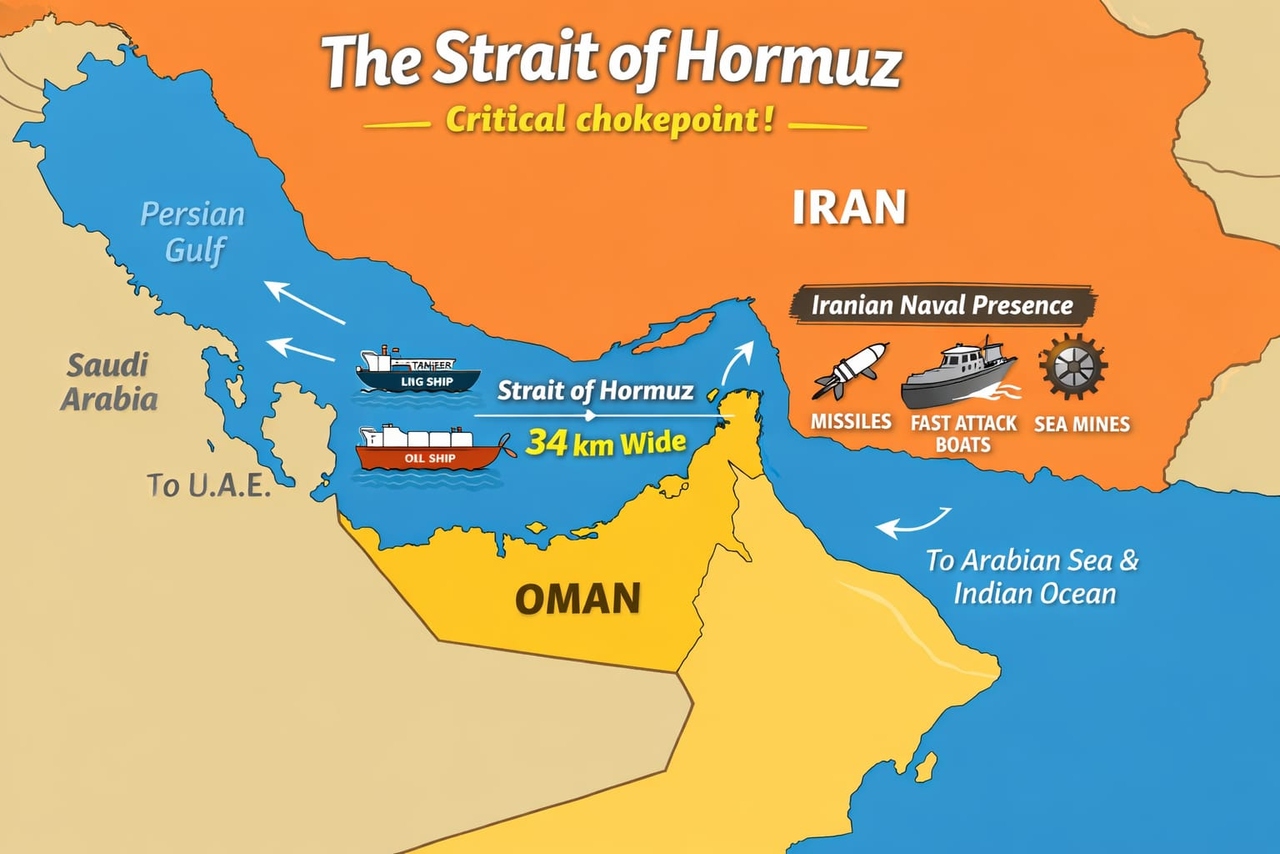
Since the US–Israel war on Iran escalated in February 2026, one name keeps appearing on global headlines and social media feeds: the Strait of Hormuz.
Once a distant line on a map, it has now become one of the world’s most critical and dangerous chokepoints.
Where the Strait of Hormuz is
The Strait of Hormuz is a narrow waterway at the mouth of the Persian Gulf, connecting it to the Arabian Sea and the Indian Ocean.
At its narrowest, it’s just 34 km (21 miles) wide, flanked by Iran to the north and Oman to the south.
All oil and LNG tankers leaving Gulf nations — Saudi Arabia, Iraq, Kuwait, and the UAE — must pass through this bottleneck. Roughly one-fifth of the world’s seaborne oil flows through it every day.
Because of its geography, even a small disruption can ripple across global energy markets.
Why Iran has the upper hand
Iran’s location along the strait gives it strategic control over shipping lanes:
Military proximity: Iranian missile batteries, fast attack boats, and naval mines line the northern side, making the strait risky for vessels during conflict.
Warnings and restrictions: Iran has cautioned that ships linked to the US or Israel may face dangers, prompting shipping firms to avoid the route entirely.
Global leverage: With such a high volume of oil and gas passing through, Iran can influence market prices and shipping decisions without firing a shot.
Selective access: Analysts suggest Tehran could allow some ships to pass while restricting others, a form of strategic pressure rather than outright closure.
This combination of geography and military capability gives Iran an upper hand in this critical maritime corridor, even against far larger naval powers.
Why Hormuz matters to the world
Even if you live thousands of miles away, the Strait of Hormuz affects you:
Fuel prices: Any threat to the flow of oil sends petrol and diesel prices soaring worldwide.
Shipping costs: Tankers and cargo ships may reroute around Africa, adding days or weeks to delivery times.
Market shocks: Energy traders react immediately, influencing stocks, currencies, and inflation globally.
In short, this tiny stretch of water carries enormous global weight. Its safety is not just a regional concern — it is a barometer for the world economy, reminding us how fragile global trade can be in times of conflict.
To advertise with us, send an email to advert@avdeltanews.world