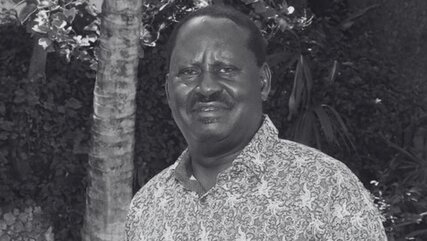

AGUTU: How Raila the Roads Minister revived the Nairobi by-passes dream
- Created by Mark Agutu
- Opinion
KICKER: Ever since Baba left us, I have nursed the idea of this 'small' story. It relates to his work as Roads Minister in the National Rainbow Coalition government. The ‘hadithi’ has persistently gnawed at the back of my mind and gets more pronounced when I drive along any of Nairobi’s remarkable by-passes.
When the euphoria of the December 2002 General Election finally ebbed, the heady feelings that followed the victory of the National Rainbow Coalition and its flagbearer Emilio Mwai Kibaki quickly changed to expectations.
After decades of rule by Kenya African National Union (KANU), a new dawn had arrived. The Rainbow dream was now a reality. And President Kibaki and his “Kibaki Tosha” or “Rainbow” team was the spearpoint of that dream.
Kibaki named his much-anticipated cabinet on March 1st, 2003, appointing Raila Amolo Odinga the Roads, Public Works, and Housing minister. The other key members of the coalition who landed appointments were Kalonzo Musyoka who was appointed Foreign Affairs ministers; George Saitoti (Education); Charity Ngilu (Health); and Moody Awori (Home Affairs). Moody Awori was later to become the Deputy President following the death of Kijana Wamalwa.
As was the tradition then, Ministers assumed their new dockets with fanfare. They would lay out their vision for the ministry, explaining how they plan to tackle lingering or emerging challenges that Kenyans face in respect of that particular docket.
So did Raila Amolo Odinga. A day or so after his appointment, Jakom convened a press conference at his office in Community.
Flanked by ministry technocrats, among them a great guy called Andrew Mondoh, ‘Baba’ confronted the issues facing Kenyans in the arena of roads, housing and public works.
I will focus on the roads. And first, the context. That the Kibaki government inherited a country with a dilapidated road network was not in doubt.
For Nairobians who can recall, the poor road network within and around the city was of great concern. Transport in Nairobi was characterised by bothersome gridlocks.
On the few thoroughfares the city boasted of Uhuru Highway and Mombasa Road were infamous for traffic jams, being as they were, the only transport corridors for trucks, personal cars, and all forms of public transport vehicles from Mombasa and to Western parts of the country.
At the press conference, which I covered, as a reporter for Daily Nation at the time, Raila had to contend with these questions from the reporters.
As was his mien, Baba would never be caught off-guard. He had come fully prepared. From the pile of papers on his desk, he fished out what turned out to be old maps of Nairobi and its environs. These were placed on a flipchart.
In response to the question on roads and transport, he started by describing the transport headache in and around Nairobi as largely due to failure by successive governments to implement a transport Master plan formulated many years back but which had been left to gather dust on the government shelves and archives.
With the dexterity of a school teacher handling chalk before an attentive class, Raila traced a pathway around Nairobi that constituted the route for the bypasses.
Starting from Cabanas area along Mombasa Road, Raila explained that plans had been made to ease traffic on Mombasa Road courtesy of the Southern Bypass - deviating from the section to the fence along Nairobi National Park, before snaking its way down to Langata, on the upper reaches of the Kibera slum, enroute to Kikuyu where it hits Waiyaki Way.
This would ensure trucks and other vehicles from Mombasa road would easily avoid passing through the City Centre where, alongside the heavy commuter transport, they would easily occasion and exacerbate the gridlocks.
Proceeding from Waiyaki, Raila explained that the Northern Bypass would meander through settlements in Kaimbu County all the way to Ruiru where it joins Thika superhighway (then Thika Road).
From Ruiru, yet another bypass – Eastern Bypass – would snake its way to Ruai, pass through Utawala and proceed to Cabanas where it joins Mombasa Road – completing a circle of sorts around Nairobi. A key aspects of the Eastern bypass was its role in diverting heavy traffic destined for Thika, Central Kenya and North Eastern region.
In Raila’s words, the planners had laid out this network to ensure motorists with no business in the City Centre could literally cruise around it to their destinations. Those from Mombasa heading to Western Kenya – especially the oil tankers – would slide on to the Southern Bypass, cruise to Kikuyu and continue with their journey. Same to those heading in the opposite direction.
Also affected was the route that planners had earmarked to provide connectivity from ABC place area on Waiyaki Way, all the way to the UN headquarters in Gigiri.
Amazingly, the bypass plan was not just about Nairobi. Most of the top urban cities in the country had their own. But interms of implementing them, Nairobi was a priority – given its rapidly growing population and strategic importance as the capital city.
But it was one thing to unveil the bypass routes, and another to convince the astounded audience - some like us hearing about the bypasses for the first time – that this vision was attainable.
“Yes, we will implement this transport masterplan for Nairobi. It is the only way we will decongest the city centre and free movement of people and goods in and around our capital city,” Raila in his characteristic confidence said.
But he acknowledged that a problem existed. Much of the government land that fell within the corridor that constituted the route for the bypasses had been allocated to individuals – including senior government officials!
The extent of the grabbing of portions earmarked for these transport corridors, was astounding, as was revealed when Raila later toured sections, journalists in tow.
Palatial homes owned by individuals, among them senior people in the Moi government and other well-known personalities, straddled the parcels of land. These were lush tracts of land, interspersed with sparkling streams of water.
The question then was: What would the government do in the face of this apparent spanner in the works.
Raila maintained that as this was public land, the same would be recovered, the homes demolished and the land put to intended.
And demolish, the government did. Months later, after the Cabinet gave its approval, with President Kibaki’s full backing, tractors and bulldozers roared into the affected sections of the bypass land.
As the reporter assigned the beat by news editors Catherine Gicheru and Erick Shimoli, I watched first-hand as homes worth millions of shillings were brought down, after the eviction notice expired.
These demolitions were front-page news in all local dailies.
One particular home in Kitisuru, owned by a well-known billionaire, who founded and ran a large consultancy with footprints across Africa, proved a tough nut to crack, defying repeated attempts by the demolition squad to flatten it.
An outstanding feature of this home was a swimming pool that bore the shape of Africa
After days of futile work by excavators, the engineers brought in high-calibre explosives and wound up the job in a matter of hours.
As heartrending as the unfolding scenes were, Raila insisted it was a matter of choosing between letting millions of Kenyans suffer as a few individuals enjoyed the comfort of property acquired from the public illegitimately.
And the law stood on Raila’s side. A number of the homeowners rushed to court for orders blocking the demolitions and seeking compensation.
However, after a couple of years of high-profile litigation in which Raila was named one of the respondents, the courts ruled that these were indeed public land and their acquisition by the affected individuals was questionable and their ownership unmerited.
The lands must be used for the original purpose they were earmarked – construction of the bypasses or whatever use the government desired, maintained the various judges who handled the petitions and appeals that arose from them.
Two decades later, Nairobians and Kenyans are enjoying the convenience of the bypasses, oblivious of the person who championed the agenda of recovering these portions of land and setting them aside for the intended purpose.
Kibaki government is credited with prioritising expansion of the road network in Kenya.
The engine of that road network transformation - at least in the early parts of the Kibaki Government - was one man, ‘Tinga’!
Awacho Ayweyo! Nind gi kwe, okew Alego Republic!