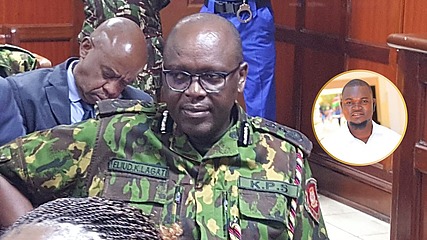

Death in police cells: Muturi wants DIG Lagat to come clean on Albert Ojwang
- Created by Juma Namlola
- Top News
He demanded that Mr Lagat immediately make public the complaint he allegedly filed against the blogger, including the date of the complaint and the office where it was submitted.
Former Public Service Cabinet Secretary Mr Justin Muturi has challenged Deputy Inspector General of Police Mr Eliud Lagat to publicly disclose the details of the complaint that led to the arrest of blogger Mr Albert Ojwang, who died in police custody under controversial circumstances.
In a strongly worded statement shared on his verified X (formerly Twitter) account, Mr Muturi condemned Mr Ojwang’s death and criticised the state for what he termed as “intimidation, silencing, and impunity."
“I strongly condemn the tragic and deeply disturbing death of Albert Ojwang. This is not an isolated case. It reflects a pattern of state intimidation, silencing, and impunity that must be stopped,” said Mr Muturi.
He demanded that Mr Lagat immediately make public the complaint he allegedly filed against the blogger, including the date of the complaint and the office where it was submitted.
“Albert was not a criminal. He was a citizen using his voice and platform to engage in public discourse,” Mr Muturi added.
“The circumstances surrounding his death, including the alleged ‘suicide attempt’ in custody, are not only questionable but outrageous.”
Inspector-General of Police Mr Douglas Kanja, speaking at a press briefing on Monday, confirmed that Mr Ojwang’s arrest was based on a formal complaint made by DIG Lagat, who accused the blogger of tarnishing his name through social media posts.
“There was a complaint that had been launched by the DIG KPS [Kenya Police Service] about his name being tarnished,” said Mr Kanja. “It is on that basis that investigations were actually being carried out because he also has a right to be protected by the same law.”
Mr Ojwang, a digital activist from Homa Bay, was arrested on Saturday, June 7, and transferred to Central Police Station in Nairobi. According to police, he was found unconscious in his cell and later died at Mbagathi Hospital.
Police claim that he injured himself by hitting his head against a wall — an account that has been rejected by civil society groups, opposition leaders, and his family.
Mr Muturi’s statement comes amid mounting public pressure on the government to address growing concerns over police conduct and the targeting of online critics.
“A state that fears criticism is a state that fears its own people,” Mr Muturi wrote. “We must protect digital freedoms and ensure that no Kenyan suffers harm for expressing an opinion.”