

Boost for women and youth groups in Lamu as they receive Sh20m grants
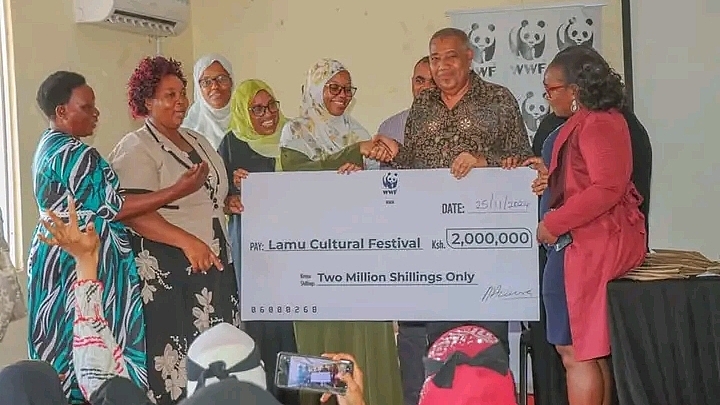
Lamu Governor Issa Timamy issuing a Sh2 million dummy cheque. The cheque will be given to youths and women. Courtesy photo
A total of 35 women groups in Lamu County are set to benefit from a Sh2 million grant provided by WWF-Kenya, through the Department of Education, Gender, Sports, and Social Services.
The financial support will enable these groups to offer indigenous and Swahili food catering services during the 22nd edition of the Lamu Cultural Festival, which runs from November 28th to 30th.
The grant targets groups affiliated with Community Forest Associations (CFAs) and Village Savings and Loans Associations (VSLAs) in the county.
It provides them with an opportunity to generate income while showcasing Lamu’s rich culinary traditions.
The funding is made possible through WWF-Kenya’s Triple Benefit, Lamu Mangrove Conservation, and Building Community Resilience through Nature-based Solutions (NbS) projects.
Speaking at the event, WWF-Kenya’s project coordinator, Mary Wambui, said the organisation is committed to empower local community especially youths and women.
"This funding goes beyond just providing financial support; it fosters a sense of community ownership, allowing women and youth to participate actively in the cultural festival and, at the same time, contribute to the conservation of our natural resources," Wambui said.
Lamu County Secretary Ali Abbas commended the partnership between WWF-Kenya and local women groups.
"This initiative is a great example of how we can integrate cultural celebration with economic empowerment. It gives our women and youth an opportunity to not only preserve but also profit from our rich cultural heritage," he noted.
The Lamu Cultural Festival, organised by the County Government of Lamu, is a key event that celebrates the region’s unique cultural heritage, promotes coexistence, and advocates for sustainable resource management.
The festival also serves as a platform for boosting ecotourism and highlighting the importance of community-based conservation efforts.
Chief Officer for Education Hafswa Difini also highlighted the festival’s role in community development.
"Through such collaborations, we are not only preserving Lamu’s history but also equipping our communities with the tools they need to thrive economically," she said.
The support provided by WWF-Kenya will be crucial in helping these women and youth groups thrive in the competitive festival environment, while reinforcing the importance of sustainable livelihoods and cultural heritage.
Ali Mohammed among the beneficiaries thanked the organisation for the funding, calling for more organisation to support youth.
"We are thankful for the grants. Through such initiatives we are able to earn a living. Many youths are going astray for lack of job opportunities. We call on the government to have programmes that empower the youths economically," he said.