

Driving change in education: The EdTech revolution shaping Kenya’s future
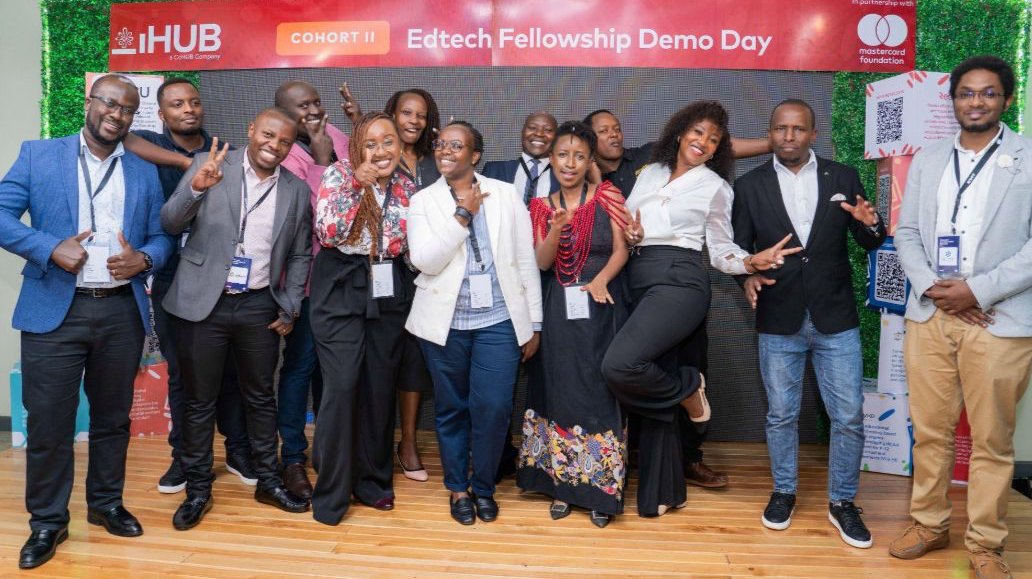
The outgoing Cohort 2 celebrates their achievements at the Nairobi Demo Day . Courtesy ihub
In Africa’s bustling education landscape, a quiet revolution is underway.
At the forefront of this transformation is the Mastercard Foundation EdTech Fellowship, an initiative designed to reimagine education through innovative technologies.
Partnering with iHub, the Fellowship supports entrepreneurs tackling some of the continent’s deepest challenges in access to learning.
This partnership is yielding groundbreaking solutions that offer hope to learners in underserved communities and beyond.
Head of Tech Ecosystem at the Mastercard Foundation’s Centre for Innovative Teaching and Learning Eliud Chimweno explains the vision behind the initiative.
“Our goal is to increase learning opportunities for young people by leveraging technology. The Fellowship not only accelerates startups but also builds ecosystems that ensure solutions are impactful and sustainable. Through collaborations with ministries, educators, and local communities, we aim to create an education landscape where technology bridges gaps rather than widens them,” said Mr Chimweno.
The Fellowship’s recent cohort of EdTech entrepreneurs, celebrated at Nairobi’s Demo Day, demonstrated the potential of this vision.
Among the standout innovators were Soma Siri Afrika, Fundi, and Studio KSL, each addressing unique educational challenges through creative approaches.
Their stories exemplify how technology, when paired with local insights, can transform the future of learning in Kenya.
Rethinking talent development with Soma Siri Afrika
Soma Siri Afrika, founded by Wabi Sherri, is not just about education, it's about preparing the next generation of problem solvers.
At the heart of its mission is a simple yet profound concept--using what children love to unlock their potential.
“We call them superheroes because that’s what they are problem solvers,” says Sherri.
Using an AI-powered app, Soma Siri Afrika integrates talent-based learning with design thinking.
Whether through coding, chess, robotics, or music, children engage in activities that hone their creativity while addressing real-world challenges.
For instance, a coding exercise might culminate in a child designing a solution to a community issue, which they then pitch to local stakeholders.
The app tracks each learner’s progress, enabling parents and educators to support personalized learning paths.
Despite its success, Soma Siri Afrika faces cultural hurdles.
“Many parents still view traditional education as the only path to success,” Sherri reflects.
“But unemployment rates and the changing job market are showing us the need for new skills. We’re helping parents see how talent-based education equips children for an unpredictable future.”
Empowering the informal sector with Fundi
Kenya’s informal sector is vast, yet most workers lack the credentials to access better opportunities.
This is the gap Fundi, co-founded by Alex Kamanga, seeks to fill.
The platform offers artisans a chance to validate their skills, receive targeted training, and earn certifications, unlocking pathways to better jobs or self-employment.
Mr Kamanga emphasizes the transformative potential of this approach.
“Imagine a painter with no formal education. Through Fundi, they can create a digital profile showcasing their work, gain insights into skill gaps, and earn certifications to compete in the job market. It’s about turning raw talent into recognized expertise.”
The challenges are significant, with 65 percent of operational skills in Kenya’s training sector still unrecognized.
Yet, Fundi’s impact is already evident, particularly among young women in rural areas. The platform’s next steps include scaling its model across the continent, providing millions more with tools to improve their livelihoods.
Breaking barriers for deaf learners with Studio KSL
For deaf children in Kenya, access to education often begins with learning a language--a journey that many struggle to undertake due to a lack of accessible materials and skilled teachers. Studio KSL, led by founder Georgine Auma, is changing this narrative.
By adapting government-approved curricula into digital content integrated with Kenyan Sign Language (KSL), Studio KSL provides deaf learners with tools to acquire language skills and achieve literacy.
The organisation employs deaf teachers and has already reached 600 learners across multiple schools, achieving a 78% improvement in language acquisition.
“Our goal is to create an inclusive environment where every child has the resources they need to succeed,” Ms Auma shares.
Yet, infrastructure challenges loom large. Many schools lack sufficient devices, forcing students to share resources and limiting personalised learning.
Studio KSL is working to address this by advocating for better teacher training and technological investments, especially in underserved areas like Wajir and Garissa.
A vision for inclusive education
As these startups work to reshape education, the Mastercard Foundation remains committed to supporting their growth. Over the next three years, the Fellowship will accelerate 36 EdTech companies, aiming to reach at least 8,000 new learners annually per startup.
Mr Chimweno underscores the Fellowship’s broader impact: “We want EdTech to become mainstream across the continent, reaching rural areas, refugee camps, and learners with disabilities. These solutions should no longer be the exception but the norm.”
With iHub opening applications for its next cohort, the promise of EdTech is clear.
Soma Siri Afrika, Fundi, and Studio KSL exemplify how local innovations can create global change, offering learners a brighter, more inclusive future.
As these stories unfold, they serve as a reminder that technology, when driven by purpose and community, can be a powerful equalizer in education.