
ECA urges partner states to help Kenya maintain Lapsset to international standards
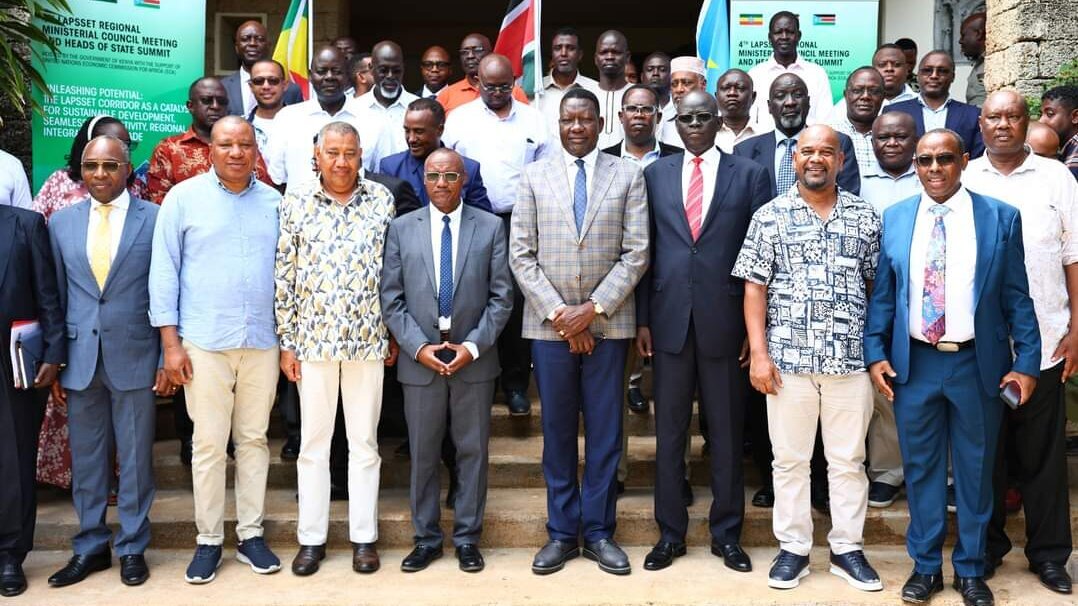
Officials take a photo shortly after the Lapsset 4th Ministerial Meeting held in Kililana, Lamu West. Courtesy photo
Lamu, Kenya
The United Nations Economic Commission for Africa (ECA) has expressed worry over what it terms a substandard Lamu Port South Sudan Ethiopia Transport (Lapsset) infrastructure.
The ECA instead is urging partner states to maintain international standards in their daily operations.
Addressing stakeholders at the Lamu Port Site in Kililana, the Director at the 4th Lapsset Ministerial Council Meeting Stephen Karingi called on the three(3) countries--Kenya, South Sudan, and Ethiopia--to prioritise the closing of missing infrastructure links in the Lapsset Corridor.
Among such infrastructure are substandard road sections that do not meet the standards of the Trans-African Highways.
These roads are unpaved or too narrow, vulnerable to adverse weather conditions among other infringements.
Mr Karingi cited the recent floods that damaged some parts of the Lapsset road infrastructure as a reminder of the need to build the missing links or upgrade them in a climate resilient way.
He also called on the three(3) countries to consider committing resources towards the implementation of the Lapsset Rail project which is a priority project of the Programme for Infrastructure Development in Africa (PIDA).
PIDA is a continental initiative adopted by all African countries to mobilise resources to transform Africa with modern infrastructure.
He also called on the three(3) countries to advance the priority value chains identified for development along the economic corridor with a regional lens.
“This will enable Lapsset to be the anchor of a sustainable development corridor which uses the Port of Lamu as an enabler of the forward and backward integration of the three(3) economies to the global value chains,” said Mr Karingi.
The director, as well, challenged the private sector and development partners to realise the full potential of the Lapsset Corridor that it requires continued commitment, strengthened partnerships, and a focus on sustainable development.
“The message for them here is to invest in the Lapsset Corridor because it is not only a priority PIDA project but also important for global infrastructure connectivity-connecting Africa to Asia and Europe,” he said.
He cited the possibility of the European Union (EU) that it could consider integrating the Lapsset Corridor into its Global Gateway Initiative.
Lapsset Corridor also fits the philosophy of China’s Belt and Road Initiative (BRI) which is about global connectivity.
Lastly, Mr Karingi noted that Africa has good examples on development corridors key success factor among them being a good coordination mechanism.
He said putting in place a regional coordination framework is critical to sustaining the momentum being celebrated currently.
“Let us, therefore, build on the work of the Joint Technical Committee, whose last two(2) meetings have generated good ideas on a Lapsset coordination framework, and associated institutions, and the recommendations are before the Ministers for their consideration,” he implored.
He also reaffirmed the ECA’s unwavering support for the Lapsset Corridor programme which represents a beacon of hope for the region, urging all stakeholders to recommit themselves to the vision and take the necessary steps to ensure the full realisation of Lapsset's potential.
This year’s 4th Lapsset Regional Ministerial Council Meeting was themed "Unleashing Potential: The Lapsset Corridor as a Catalyst for Sustainable Development, Seamless Connectivity, Regional Integration, and Trade."
On his side, Lapsset Chief Executive Officer (CEO) Stephen Ikua underscored the importance of harmonising efforts under the Regional Coordination Mechanism to ensure that the benefits of the Corridor extend beyond individual nations, fostering a strong, unified economic bloc across the region.
Lamu Governor Issa Timamy reiterated Kenya's unwavering support for the Lapsset Programme, emphasising the importance of close collaboration with national and regional partners to ensure that the Corridor's benefits are realised by all.
He also highlighted the need to preserve Lamu's cultural and natural heritage while embracing the opportunities that lie ahead.