
Focus on private consultancy firm in ongoing Sh2.2bn probe at Moi University
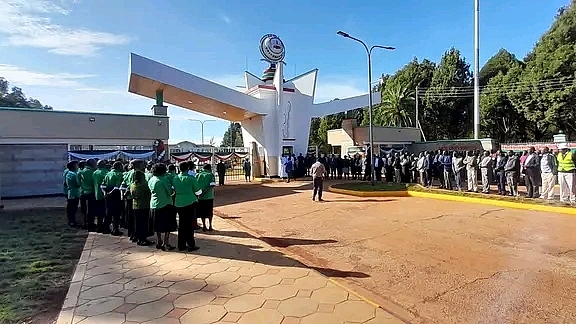
Students and Moi University management during the opening of the institution's modern gate recently. The Government has moved to address the standoff at the institution which was indefinitely closed a month ago following students' unrest. Photo/Jeremiah Choge
The Ethics and Anti-Corruption Commission (EACC) is narrowing down to a private consultancy firm in the ongoing probe into Sh2.2 billion corruption scandal at the troubled Moi University.
Detectives privy to the investigation believe that Habitech Consultants was used by top university officials to siphon funds.
Moi University Vice Chancellor Prof Isaac Kosgey who was on Wednesday grilled for over eight hours at the Commission's North Rift offices in Eldoret promised that the University will cooperate with detectives.
"We have nothing to hide. We are ready to cooperate with the Commission and shed light on any information they may be in need of. Journalists are also welcome to tour the institution and get any information they want," Prof Kosgey told journalists after being grilled.
In a statement to newsrooms, EACC confirmed that it is seized of the matter and investigations are ongoing.
"The Commission commenced investigations in June 2024 upon receipt of a report that Senior Management Officials in Moi University had in collusion with private consultants hatched a scheme for illicit enrichment through fraudulent and irregular multi-million tender awards for major development projects," the EACC read in part.
According to the commission, it was further alleged that in the implementation of its development projects, Moi University management deliberately avoided the free services of existing Government Professionals from the Ministry of Public works in its tendering processes.
"Notably, Habitech Consultants, which have been engaged by the University over the last seven years, are reported to have been aiding top University Officials to execute corruption scams embedded in infrastructural projects," EACC said in their statement.
"As part of the ongoing investigations, the Commission has interviewed and recorded a Statement from the University Vice Chancellor, Prof Isaac Kosgei, who is CEO and Accounting Officer of the Institution. So far, the Commission has recorded 59 statements," added the Commission.
The Commission has also summoned four(4) Members of the University Council believed to be in possession of crucial information to aid the investigation.
"The outcome of the investigation will inform appropriate action against any persons found culpable, in accordance with the law," the Commission's statement read further.
"Meanwhile, the Commission expects the University to fully cooperate and support the investigations to ensure expeditious completion of the matter," added the statement.
The University was closed following protests by the students on October 3, who expressed frustration over the Vice Chancellor’s move to close the institution noting that the decision threatened their right to education.
During the protests, the students called for the immediate resignation of Prof Kosgey whom they accused of poor management of the school including failing to heed the grievances raised by the school workers.
Consequently, the VC ordered an indefinite closure of the school, after a meeting of the Senate resolved to suspend teaching and learning activities at the institution.
“The University Senate in a Special Meeting held on October 3, 2024, resolved to suspend the teaching and learning activities of the 1st Semester 2024/2025 Academic Year as a consequence of the industrial action of staff and subsequent student unease,” the statement from the VC then read in part.
The financially strained Moi University has opted to layoff some of its staff in 2022 as part of addressing the ballooning wage bill that had strained the institution's operations.
According to the University, the institution has been facing difficulties in meeting its wage bill obligations.
Through an internal memo, Prof Kosgey said recurring expenditures including the wage bill took up about 70 per cent of the funds adversely affecting the running of the institution.
"Over the years, the university wage bill has been increasing taking over 70 percent of the capitation from the Exchequer," said Prof Kosgey then.
He said that with the continued decline in revenues, the University is unable to sustain the growing wage bill and as such it has become necessary to undertake the move to ensure sustainability of the University and its operations.
"Towards this end, the university is considering reduction of its staffing levels that will call for compulsory redundancies," the memo read further.
"This is therefore to notify you of the impending redundancy of staff due to continued strain by the University to fully fund its wage bill and to align Human Resource to the existing workload," added the memo.
Moi University is estimated to have at least 10,000 staff members, with 1,000 of those on payroll alleged to be ghost workers.
The institution has been struggling financially with the Auditor-General Nancy Gathungu in a 2018-2019 report saying the university’s debts had exceeded Sh4.5 billion.
According to University Council Chairperson Humphrey Njuguna, debts had accrued to more than Sh5 billion by September 2023 paralysing some of its operations.
The Kesses-based institution of higher learning has attributed its financial woes to the closure of satellite campuses and the scrapping of certain courses three(3) years ago.