
2025 World Athletics Championships: Kenya’s women carry the nation’s pride as team shines in Tokyo
As the curtains closed on the 2025 World Athletics Championships in Tokyo on Sunday, Kenya etched another proud chapter in its rich athletics history.
With 7 gold, 2 silver, and 2 bronze medals, Team Kenya placed second overall behind the United States.
But what made this outing especially memorable was that six(6) of those seven(7) gold medals were claimed by Kenyan women, leaving just one(1) male gold winner--Emmanuel Wanyonyi in the men’s 800 metres.
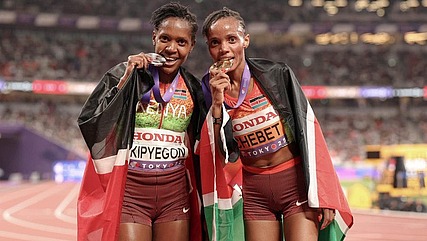
Tokyo 2025 will be remembered not only for medal counts but for the stories behind them: surprise triumphs, tactical races, and performances that announced new stars on the world stage. Kenya’s campaign launched in style when Beatrice Chebet claimed gold in the women’s 10,000 metres on 13 September in a thrilling race. She surged past Italy’s Nadia Battocletti and Ethiopia’s Gudaf Tsegay in the final lap to win in 30:37.61. Chebet didn’t stop there.
On Saturday, she doubled up by winning the women’s 5,000 metres in dramatic fashion, edging her compatriot Faith Kipyegon in a sprint finish, clocking 14:54.36 against Kipyegon’s 14:55.07. The duel between the two was billed as epic—and it delivered.
Another gold came from Peres Jepchirchir in the marathon on 14 September, where she held off a fierce finish by Ethiopia’s Tigst Assefa to take the title in 2:24:43. Handling the humidity and pressure superbly, Jepchirchir added this world crown to her already distinguished resume.
On 17 September, Faith Cherotich stunned the world in the women’s 3,000 metres steeplechase. The 21-year-old overtook reigning champion Winfred Yavi of Bahrain on the final lap, cleared the last water jump with power, and set a championship record of 8:51.59.
Then came the surprise of the championships: Lilian Odira, relatively unknown before Tokyo, upset Britain’s Georgia Hunter-Bell and Keely Hodgkinson in the women’s 800 metres final on the last day. Odira produced a personal best and championship record of 1:54.62, riding a forceful push in the final 30 metres to grab gold.
Meanwhile, Faith Kipyegon defended her title in the women’s 1500 metres, showing tactical mastery and pace control, reminding the world why she remains one of Kenya’s greatest middle-distance runners.
Kenya’s only gold from the men’s contingent came from Emmanuel Wanyonyi in the men’s 800 metres final on 20 September. His run was tactical, timed perfectly, and he crossed the line ahead of strong international competition. There were also solid performances: Reynold Cheruiyot took bronze in the men’s 1500 metres, and Edmund Serem claimed bronze in the men’s 3000 metres steeplechase.
These showed depth, but also raised questions about Kenya’s capacity to break through in sprint events and the more technically demanding field disciplines. For all the gold medals, there were notable near misses and races that challenged expectations.
Some athletes fell just short of the podium; others ran personal bests but could not maintain the finishing kick required in championship finals.
The margins were tight, especially in middle-distance and distance races, where Kenyan dominance is expected but competition is now stiffer.
Among the most inspiring stories was Lilian Odira’s victory. A mother who returned to peak form after childbirth, she showed remarkable mental toughness and race intelligence. Her final 800m gold was unexpected by many analysts, but earned with poise.
Beatrice Chebet not only won two(2) gold medals, but did so with cool strategy, timing her final sprint wisely and joining the rare club of distance runners who claim both the 5,000m and 10,000m in a single championship. Faith Cherotich, still young, delivered under pressure, overtaking a reigning champion in the last lap and setting a championship record, a sign that Kenya’s future in steeplechase remains secure.
Peres Jepchirchir’s marathon was another masterclass in experience, handling heat, humidity, and pace to perfection.
Finishing second on the medal table with 7 golds is a major leap from recent global championships.
At Budapest 2023, Kenya won 10 medals but fewer golds; this time, the nation improved not just total medals but claimed more titles. The women’s dominance—six golds out of seven—not only improves statistical records but also shifts narratives.
Kenya is no longer just relying on the grace and strength of a few stars; it shows a growing wave of female athletes who can perform under championship pressure.
It is a boost for gender equity in sport, representation, and national expectations.
Final medal table — Tokyo 2025 World Athletics Championships
| Rank | Country | Gold | Silver | Bronze | Total Medals |
| 1 | United States | 16 | 5 | 5 | 26 |
| 2 | Kenya | 7 | 2 | 2 | 11 |
| 3 | Jamaica | 1 | 6 | 3 | 10 |
| 4 | Canada | 3 | 1 | 1 | 5 |
| 5 | The Netherlands | 2 | 2 | 2 | 6 |
| 6 | Spain | 2 | 0 | 1 | 3 |
| 7 | New Zealand | 2 | 0 | 1 | 3 |
| 8 | Sweden | 2 | 0 | 1 | 3 |
| 9 | Portugal | 2 | 0 | 0 | 2 |
| 10 | Italy | 1 | 3 | 3 | 7 |
Kenya’s run in Tokyo was more than just tallying medals--it was a story of young talents stepping up, women leading from the front, and a country reasserting its dominance in athletics.
The challenge now is to consolidate this performance, address the weaker links, and build systems that propel more athletes--male and female--towards gold. Tokyo 2025 has set a high bar. Kenya has met it with glory.
The question is whether the momentum can be sustained for championships to come.