
Raila Odinga’s five bids for State House: A journey of hope, heartbreak, and history
- Created by Juma Namlola
- Profiles
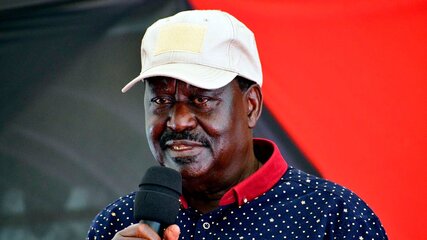
After the contested 2007 presidential election results, Raila Odinga became Prime Minister in a coalition government.
When Kenyans look back on the life and legacy of Raila Amolo Odinga, one truth stands tall.
That truth or fact is that few men and women have shaped the nation’s political destiny like him.
For more than two(2) decades, he was not just a candidate, but a cause. Not simply a politician, but a ‘movement’.
Raila’s five(5) attempts at the presidency--in 1997, 2007, 2013, 2017, and 2022--tell the story of Kenya’s democratic struggle, its fragile hope, and its enduring resilience.
The first leap — 1997
It was 1997 when Raila first appeared on the presidential ballot. The air was still thick with the new scent of multiparty politics.
Standing under the banner of the National Development Party (NDP), the then-Lang’ata MP faced political heavyweights including President Daniel arap Moi and Mwai Kibaki.
He finished third, far behind the two frontrunners. Yet, that defeat became a foundation.
It introduced Raila to the national stage as a bold reformist willing to challenge the establishment.
Later, in a surprising political twist, he joined Moi’s government as Energy Minister after merging NDP with KANU in 2001 — a move that divided opinion but expanded his experience in statecraft.
The near victory that broke Kenya — 2007
10 years later, Raila led the Orange Democratic Movement (ODM) into what became one of Kenya’s most fiercely contested elections. His rival, President Mwai Kibaki, was seeking re-election.
When the Electoral Commission of Kenya declared Kibaki the winner, chaos erupted. Odinga’s supporters claimed the results were manipulated.
The ensuing violence left over 1,000 people dead and hundreds of thousands displaced.
The crisis ended with a power-sharing deal brokered by the international community.
Raila became Prime Minister in a coalition government — a bittersweet consolation that many saw as both victory and tragedy.
The New Constitution era — 2013
With a new constitution in place and hopes of a fairer process, Raila tried again in 2013, this time against Uhuru Kenyatta.
The election was peaceful, but the outcome familiar. Kenyatta was declared winner with just over 50 percent of the vote.
Raila disputed the tally in the Supreme Court, which upheld Kenyatta’s victory.
Though he accepted the verdict, Raila continued to accuse the electoral body — the Independent Electoral and Boundaries Commission (IEBC) — of irregularities.
His mantra of “no reforms, no elections” became a rallying cry for many who believed the system was still flawed.
The historic annulment — 2017
Raila’s fourth attempt, in 2017, against Uhuru Kenyatta again, produced a landmark moment.
After IEBC declared Kenyatta the winner, Odinga challenged the result in court. In a ruling that stunned Africa, the Supreme Court annulled the election, citing massive irregularities.
It was the first time a presidential election had been nullified in Kenya — and only the fourth such case in the world.
But Raila boycotted the repeat poll, claiming the same system could not produce a different result.
In January 2018, he famously swore himself in as the “People’s President”, sparking a constitutional standoff.
It ended with the handshake between him and Uhuru Kenyatta in March that year.
That handshake reshaped Kenya’s politics, cooled tempers, and later birthed the Building Bridges Initiative (BBI) — a reform project that, though later halted by the courts, sought to unify the country and fix deep-rooted governance issues.
The final bid — 2022
Raila’s fifth and final attempt came in 2022, at 77 years old. Backed by outgoing President Uhuru Kenyatta under the Azimio la Umoja–One Kenya Coalition, he faced William Ruto, a one-time ally turned rival.
It was a close race. The IEBC declared Ruto the winner with 50.49 percent, against Odinga’s 48.85 percent.
Raila returned to the Supreme Court, alleging manipulation of the tallying process. The court again upheld the results.
It was another heartbreak. Yet, his concession statement was calm, measured, and rooted in his belief that democracy must be preserved even in defeat.
“We have fought for democracy all our lives. We will continue to do so, because Kenya is bigger than any one of us,” he told supporters in Nairobi.
The unbroken legacy
Over five(5) elections and 25 years, Raila Odinga never reached State House — but he redefined the meaning of opposition, resistance, and reform in Kenya.
Each of his bids pushed for greater transparency, judicial independence, and constitutional integrity.
His political resilience inspired millions, while his losses forced institutions to change and adapt.
Read: Raila Odinga collapses in India and dies, family to issue statement soon
Even in death, Raila’s shadow will loom large over Kenya’s democracy. His was a journey of unfinished dreams--of hope repeatedly deferred, but never extinguished.
And as Kenya mourns him, one truth resonates…Raila Amolo Odinga may never have become president, but he helped build a nation where every citizen can still dream of becoming one.