

Kenya gets major UHC boost as WHO donates 14 ambulances, critical health supplies
Kenya’s pursuit of Universal Health Coverage (UHC) received a significant boost on Thursday when the World Health Organisation (WHO) officially handed over medical equipment and vehicles worth approximately USD 2.3 million (about Sh350 million).
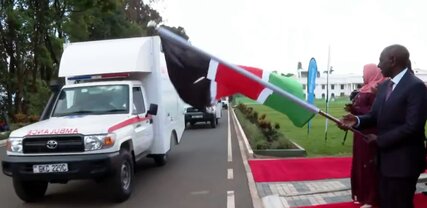
President William Ruto presided over the ceremony at State House, Nairobi, where the donation was formally flagged off.
The package comprises 14 fully-kitted ambulances and eight advanced life-support units that will bolster the country’s National Emergency Ambulance Centre.
A further six specialised ambulances will be allocated to maternal and reproductive health services in remote counties, aiming to reduce preventable deaths caused by delayed emergency care.
Also included in the consignment are 205 medical oxygen cylinders, nearly 3,000 sets of infection-prevention materials for emergency response, and 6.5 million deworming tablets for distribution across 15 counties, providing protection for an estimated three million people against soil-transmitted parasitic infections.
Speaking at the event, WHO Regional Director for Africa, Prof Mohamed Janabi, described the donation as a powerful symbol of international solidarity in building resilient health systems.
“This is not simply aid. It is a shared commitment to saving lives at community level, where outbreaks and emergencies both begin and end,” he said.
President Ruto welcomed the support, stating that it reinforces Kenya’s determination to deliver equitable healthcare to all citizens.
“Every Kenyan life is precious. Every citizen, he said, has a right to the highest attainable standard of health as guaranteed by Article 43 of the Constitution,” he remarked.
He affirmed the government's commitment to ensure that every citizen, regardless of their social and financial status, gets better medical care.
The advanced life-support vehicles will be stationed at the seven national referral hospitals and the central emergency response hub.
Counties including Elgeyo Marakwet, Marsabit, Siaya, Samburu, and Tana River will receive the dedicated maternal-health ambulances.
The President noted that the new resources will enhance emergency referral systems, expand oxygen availability, and help lower maternal and newborn mortality rates, while also improving preparedness for outbreaks such as cholera and mpox.
Health Cabinet Secretary Aden Duale pledged continued government efforts to eliminate preventable maternal and child deaths, and Health Principal Secretary Mary Muthoni praised WHO’s longstanding partnership with Kenya.
CS Duale assured President Ruto that Kenya is a committed member to WHO and that it has met all the obligations.
He said the donations flagged off on Tuesday at State House event, will mainly help reduce mother and child mortality in the health facilities.
“It is sad to see our mothers when they go to health facilities they lose their lives. As leaders, we are committed to ensuring that when a mother walks to the health facility, she is able to give birth in good conditions,” CS Duale said.
In March 2017, WHO donated 15 ambulances to six Kenyan counties--Migori, Wajir, Mandera, Marsabit, Isiolo, and Lamu--to support reproductive, maternal, newborn, child, and adolescent health initiatives.
This was part of a UN-wide effort through the RMNCH Trust Fund, focusing on improving referral strategies, emergency training, and maternal mortality reduction.
Marsabit Governor Ali Mohammud, representing the Council of Governors, expressed gratitude for the donation, saying it would significantly complement devolved health services across the country.
To advertise with us, send an email to advert@avdeltanews.world