

Kenya’s Haiti mission: Homecoming and the human cost of peacekeeping
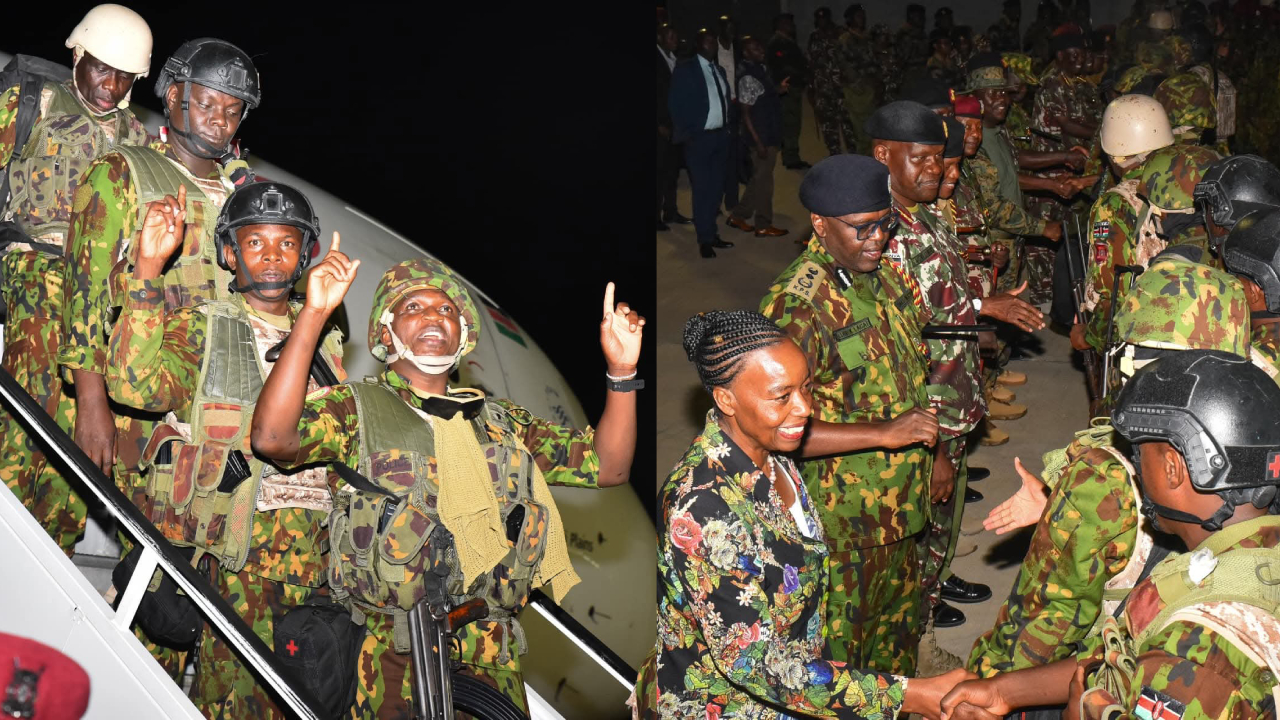
National Security Advisor to the President, Dr Monicah Juma, welcoming the first batch of Kenyan officers from Haiti mission. Photo/Courtesy
When the first batch of Kenyan officers arrived at Jomo Kenyatta International Airport on Tuesday, their return brought relief and a heavy reminder of the price paid in Haiti.
For the past 18 months, under the Multinational Security Support Mission (MSS), later restructured as the Gang Suppression Force (GSF), Kenyan officers deployed deep into Haiti’s most troubled territories.
Their mandate was to help restore stability, reopen critical road networks and support training of local law enforcement.That mission did yield tangible results.
Several highways and arterial roads, long choked by gang checkpoints, were reopened, restoring freedom of movement for civilians and goods.
Key bases and strategic zones, previously under gang control, were retaken, offering pockets of relative security in a capital under siege.Yet the mission came at grave cost.
On February 23, 2025, Samuel Tompoi Kaetuai, one of the deployed officers, was shot during an operation in the Artibonite region and later died.
A second officer was killed after their patrol vehicle was ambushed in gang-controlled territory.
Worse still, in August 2025, Kennedy Mutuku Nzuve lost his life in a tragic crash involving armoured vehicles on the Kenscoff–Pétion-Ville road.
Families remain anguished, especially those of officers killed or missing after ambushes or accidents.
Some returning officers also spoke quietly of poor equipment, insufficient manpower and constant exposure to danger.
In certain operations, armoured vehicles failed to shield them effectively, leaving officers vulnerable even behind protective gear.
At Tuesday’s reception, grief mingled with pride.
The officers who made it back received a heartfelt welcome.
Leaders acknowledged that while not every target was met, the mission’s gains (reopened roads, restored pockets of security, trained local police) mattered.
At the reception ceremony, Ambassador Monica Juma, National Security Advisor to the President, led a moment of silence for officers who lost their lives during the mission.
She highlighted their courage, noting that their sacrifice remains a proud part of Kenya’s international peacekeeping legacy.
Dr Juma also praised Kenya Airways for ensuring smooth and reliable travel for the mission.
Deputy Inspector General (Kenya Police) Eliud Lagat congratulated the returning officers for their professionalism and for overcoming operational challenges that tested their skill and resolve.
His Administration Police Service counterpart Gilbert Masengeli commended the team’s unwavering commitment to peace and security.
“Your unwavering commitment has strengthened Kenya’s reputation as a reliable partner in international peacekeeping efforts,” said Mr Masengeli.
On Wednesday (today), the officers who returned were hosted by Interior Cabinet Secretary Kipchumba Murkomen at Embakasi “A” Campus in Nairobi.
For Kenya, the return marks more than the end of a deployment. It is a chapter in a complicated legacy where valour and heartbreak co-exist.
And for the families of the fallen, it is a painful reminder that peacekeeping sometimes demands a price beyond measure.
To advertise with us, send an email to advert@avdeltanews.world