

KWS captures stray lion in Ongata Rongai
- Created by Joel Mulinge
- Top News
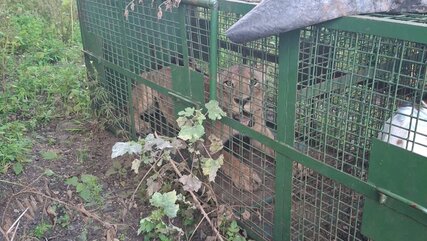
The young male lion was safely captured at Sorora Drive, Rimpa, Kajiado North, in the same homestead where a lioness was trapped earlier January.
A team of rangers and vets from the Kenya Wildlife Service (KWS) on Thursday safely evacuated a sub-adult lion that strayed from Nairobi National Park into Ongata Rongai on the outskirts of Nairobi.
The wildlife agency said that the young male lion was safely captured at Sorora Drive, Rimpa, Kajiado North, in the same homestead where a lioness was trapped earlier January.
“The lion will be released back to Nairobi National Park, after a health check at the KWS Vet Clinic,” KWS said in a statement.
Last week, a lioness was captured in the same area after it strayed from Nairobi National Park.
“The captured lioness was a threat to the public and had been involved in several incidents of domestic animal predation,” KWS said.
Cases of wild animals, especially lions, being spotted in public areas within Nairobi and its environs have been common in the recent past.
In 2024, KWS was forced to dispatch a special team to hunt down a lioness which was spotted in a residential area of Ongata Rongai in Kajiado County.
The lioness was captured on CCTV scaling a boundary wall and snatching a pedigree dog from a private residence in Nazarene residential area.
In a statement, KWS said the Human-Wildlife Conflict (HWC) team was pursuing the lioness after the CCTV footage went viral on social media.
“Our Human-Wildlife Conflict (HWC) team is actively pursuing the dangerous big cat. KWS assures residents that the HWC team continues to patrol the area, supported by the more experienced Problem Animal Management Unit (PAMU),” the agency said then.
“The public is informed that heavy rains, such as those experienced recently in Nairobi, cause herbivores to migrate through the unfenced southern part of Nairobi National Park towards settlements such as Rongai, Kitengela, Athi-Kapiti and the wider Kajiado area and its environs, where waterlogged soils and areas of over-long grass provide hiding places for predators.”
KWS added that these conditions attract predators such as lions, leopards and hyenas, which follow their prey into these areas.
“This movement of predators leads to unfortunate incidents like the one captured on CCTV,” it added.
KWS said that 80 per cent of Nairobi National Park is fenced, meaning the animals have escape routes, but assured that the city is safe from wildlife attacks.
Cases of human-wildlife conflict in Rongai have escalated in recent years as the human population has increased and encroached on areas originally occupied by wildlife.
Nairobi National Park is the only park in the world that is within a city. Although it has an electric fence to keep the animals inside and humans from encroaching.
To advertise with us, send an email to advert@avdeltanews.world