

ODM at 20 without Raila: How the former PM had planned to lead party celebrations
Before his death in India on Wednesday morning, Raila Amolo Odinga had planned to lead celebrations marking 20 years of the Orange Democratic Movement (ODM).
The party he helped build in 2005 is the one organisation he remained in longest.
Over the decades Raila moved through several political groupings — from FORD-Kenya to the National Development Party (NDP), into a merger with KANU, into the National Rainbow Coalition (NARC) and, finally, to ODM — but it is ODM that became his enduring political home.
Raila’s time in national politics began in earnest after his release from detention in the early 1990s. He joined FORD-Kenya and later left to lead the National Development Party, which he transformed from a minor formation into a significant regional force in the 1990s. The NDP’s rise in Nyanza and its appeal in subsequent elections set the stage for a critical realignment at the turn of the century.
In 2001–2002 the NDP formally merged into KANU in a deal that surprised many Kenyans. As part of that power-sharing arrangement, Raila was appointed to President Daniel arap Moi’s cabinet as minister of energy in June 2001.
He was later elected secretary-general of the restructured party — a post widely reported in contemporaneous and later accounts of the merger.
The nickname “Tinga” traces to that earlier phase of his political life. Supporters linked Raila to the tractor emblem used by NDP and allied groups during the 1990s. Over time the tag “Tinga” — a Swahili rendering tied to the tractor image — stuck as a popular sobriquet for Raila. The name became part of his political brand long before ODM’s formation.
The NDP–KANU union was short-lived. When President Moi signalled his preference for Uhuru Kenyatta as successor, Raila and his followers walked away. The split fuelled the creation of a broad opposition front that coalesced into the National Rainbow Coalition (NARC), which carried Mwai Kibaki to the presidency in 2002.
The immediate trigger for ODM’s birth was the 2005 constitutional referendum. The vote proved polarising. On the ballot, symbols were used to represent the two options: orange for the No side and banana for the Yes side.
Samuel Kivuitu, who was then chairman of the Electoral Commission of Kenya (ECK), presided over the process in which those symbols were placed on the ballots for voters to recognise. The No camp’s orange symbol quickly became a rallying emblem for opponents of the draft constitution.
Out of that campaign and its organisational structures, the Orange Democratic Movement emerged as a political vehicle.
In the early months of ODM’s formation a small cluster of senior leaders played visible roles in shaping strategy and outreach. Commentators and political histories commonly refer to a core group — sometimes called the Pentagon — of influential figures who were instrumental at the party’s founding and early mobilisation.
With his four colleagues, they were refered to as the Pentagon. Aoart from Raila, others were; William Ruto, Musalia Mudavadi, Najib Balala and the late Joe Nyagah.
From the 2005 referendum onwards, ODM grew into the main opposition formation.
Raila led the party into the 2007 election as its presidential candidate. The years that followed forged ODM into one of Kenya’s largest political movements.
Raila contested the presidency again in 2013, 2017 and 2022 under the ODM banner. Despite internal divisions at various moments, the party’s national structures and networks endured, making ODM the organisation Raila stayed with the longest in his political life.
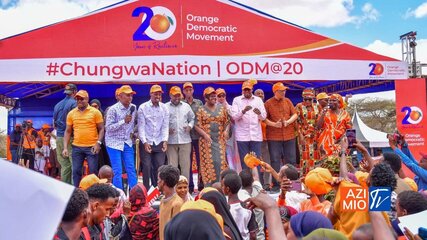
This year, ODM planned a high-profile 20th anniversary celebration in Mombasa. The leadership initially scheduled the main event for October 10–12, 2025. The party’s organising committee, chaired by the parliamentary opposition leader Junet Mohammed, outlined a programme of county tours and local activities to precede the Mombasa gathering.
The idea was to hold county-level shows and community events across the country so that the national celebrations would reflect participation from all regions.
Organisers also opened delegate registration for county representatives and said they would run cultural, youth and women’s programmes, sports fixtures and public exhibitions in the run-up to the main event.
Reports from party briefings and media accounts indicate that the leadership later adjusted the schedule to expand outreach. The Mombasa dates were moved to November 14–16, 2025 to allow additional county engagements and to deepen participation in areas that had not yet hosted ODM@20 activities.
The party said the postponement was not a cancellation but a tactical shift to take the anniversary to more Kenyans.
The ODM secretariat publicly listed satellite events and county stopovers that would form part of the lead-up to Mombasa. Those preparations were handled by the national organising team, county chapters and the central communications office under the ODM secretary-general.
Raila’s political path underscores two consistent patterns. First, he repeatedly sought alliances that could broaden his political reach — alliances that sometimes meant entering old structures and at other times meant breaking away to create new ones. Second, notwithstanding those shifts, ODM became the lasting institution of his later career.
The party’s two-decade existence under his leadership was the framework for his successive presidential bids and his role as a national opposition figure.
To advertise with us, send an email to advert@avdeltanews.world