

2027 General Election will be decided by cost of living – Infotrak poll
- Created by Juma Namlola
- Politics
One in every two voters says economic pressure on households will determine their presidential and party choices.
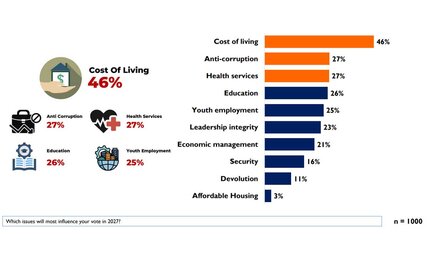
The rising cost of living will be the single most decisive factor influencing how Kenyans vote in the 2027 General Election, according to the Infotrak End-Year Poll released on December 28, 2025.
Nearly one in every two voters (46 percent) says economic pressure on households will determine their presidential and party choices, setting the stage for an issue-driven political contest rather than personality or ethnic loyalty.
The survey of 1,000 respondents across all 47 counties, conducted through Computer Assisted Telephone Interviews (CATI), shows that Kenyans are entering the election cycle with economic survival at the top of their minds.
Infotrak data reveals that the economy is the strongest vote determinant, overtaking traditional mobilisation tools such as ethnicity, party loyalty and regional networks.
Food prices, taxation anxiety, weakening purchasing power and rising household expenses form the core of public frustration.
Following cost of living, the poll lists the next major voting issues as:
| Issue that will influence vote in 2027 | Percentage (%) | |
| 1 | Cost of living | 46 |
| 2 | Anti-corruption | 27 |
| 3 | Education | 26 |
| 4 | Youth employment | 25 |
| 5 | Leadership integrity | 23 |
| 6 | Economic management | 21 |
| 7 | Security | 16 |
| 8 | Devolution | 11 |
| 9 | Affordable housing | 3 |
According to the Kenya National Bureau of Statistics (KNBS), national inflation--a primary measure of the cost of living-- was reported at 4.5pc year-on-year in November 2025.
This means that, on average, the prices of goods and services purchased by households were 4.5pc higher compared to the same month in 2024.
Food and non-alcoholic beverages were among the main drivers of price increases, rising by 7.7pc over the year, while transport and housing costs also contributed to overall inflationary pressure.
The Consumer Price Index (CPI), the broad indicator the government uses to track price changes affecting everyday expenses, has shown a modest rise through 2025, with recorded CPI inflation of 4.1pc in July and 4.6pc in October before settling at 4.5pc in November.
These inflation figures, while within the Central Bank of Kenya’s target range of 2.5pc to 7.5pc, still reflect persistent increases in essential costs, particularly food and transport, which directly affect household budgets and are frequently cited by consumers as a key concern.
The Infotrak findings indicate that 27 percent of Kenyans rank anti-corruption as a top priority, a sign of intensifying impatience with scandals in public office.
Health and education follow closely, each at 27 percent and 26 percent respectively, signalling growing demand for accessible hospitals, affordable medication, fair teacher staffing and reduced school-related costs.
Similarly, 25 percent highlighted youth employment, reflecting a demographic tension in a country where more than half of the population is under 35.
For many young people, the ballot has become both protest and negotiation.
Leadership character also matters: 23 percent will vote based on integrity, a figure that could penalise leaders facing ethical controversy.
While presidency races traditionally ride on alliances and personalities, the Infotrak numbers paint a shifted electorate mindset--one in which policy performance may outweigh tribe or party colour.
With 21 percent citing economic management directly, and 46 percent indirectly through cost of living concerns, political formations face pressure to present credible economic recovery plans.
Security, devolution management and affordable housing appear lower in priority, but a sudden national shock could quickly alter rankings.
The poll suggests the 2027 electoral battlefield will be decided at the dinner table, not political rallies.
Parties promising inflation relief, job creation and accountability may find easier traction than those relying solely on mobilisation structures.
As the political temperature rises, campaign messages are expected to pivot heavily toward prices, jobs, accountability, healthcare, education costs and leadership trustworthiness.
The 2027 vote, if these indicators hold, may be remembered as Kenya’s first truly issue-based election.
To advertise with us, send an email to advert@avdeltanews.world