

Over 85 percent of Nairobi buildings unsafe, experts warn
- Created by Sande Onyango
- Top News
Professionals in the build industry warn 85 percent of Nairobi buildings are unsafe, demand accountability after South C building collapse.
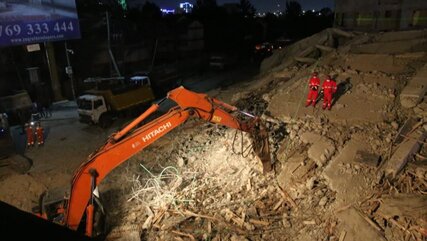
Professionals in Kenya’s building and construction industry have called for a swift and thorough investigation into the collapse of a storey building in Nairobi’s South C area, warning that those who approved additional floors must be held personally accountable for breaching professional standards.
Addressing the media about a week after the deadly collapse, the professionals, drawn from the Institution of Engineers of Kenya (IEK), The Architects Alliance (TAA), the Kenya Institute of Planners (KIP), and other bodies, painted a grim picture of the state of construction in the country, revealing that the majority of buildings in Nairobi are unsafe for occupation.
They said the disaster was a clear manifestation of systemic failures driven by corruption, greed, and weak enforcement of building regulations.
“The developer has the first duty of care of engaging qualified consultants, while the contractor has a duty of care when it comes to quality, processes, and approvals,” said TAA President Sylvia Kasanga.
“Those responsibilities cannot be ignored.”
Kasanga further questioned the role of regulators, urging decisive action against rogue contractors.
“Can the National Construction Authority blacklist all contractors with violations and make that information public?” she asked.
IEK President Shammah Kiteme raised concerns over professional accountability at construction sites, questioning whether registered engineers are actually involved in projects they are linked to on paper.
“Who was the responsible structural engineer? Is it the one reflected in NCA records or the one actually on site?” Kiteme posed.
Architectural Association of Kenya (AAK) President George Ndege emphasized that structural integrity begins at the foundation and cannot be altered midway to accommodate commercial interests.
“You do not add another floor simply because you have more tenants,” Ndege said.
“Structural calculations start from the foundation. If the foundation was not designed for additional floors, you cannot add them later.”
Beyond the South C incident, the professionals issued a stark warning on the overall safety of buildings in the capital, revealing that about 85 per cent of buildings in Nairobi are unsafe for habitation.
According to Kiteme, inspections conducted by the Nairobi Building Inspectorate on approximately 15,000 buildings found that only 15 percent met safety standards.
“You are talking about all the others being unsafe,” he said.
Ndege warned that the situation poses a serious risk to public safety, even in the event of minor disturbances.
“If a tremor, even on a very low Richter scale, were to occur, many buildings would come down,” he said.
“If you have to switch on your lights during the day because of poor design, that is a problem. If there is an open sewer outside your house, that is a problem.”
The professionals reiterated that the South C collapse was preventable and called for urgent reforms, stricter enforcement of regulations, and accountability across the construction value chain to avert future tragedies.
“These are systemic issues, and they are largely preventable,” Kiteme said.
To advertise with us, send an email to advert@avdeltanews.world