
Cricket Kenya appoints interim CEO amid deepening boardroom wrangles
- Created by Sande Onyango
- Sports Extra
Walter Trenk Mukinginyi takes charge of operations, assets, records, finances, and staff discipline.
The Cricket Kenya Council has appointed Walter Trenk Mukinginyi as Interim Chief Executive Officer with immediate effect, granting him authority over the federation’s day-to-day operations.
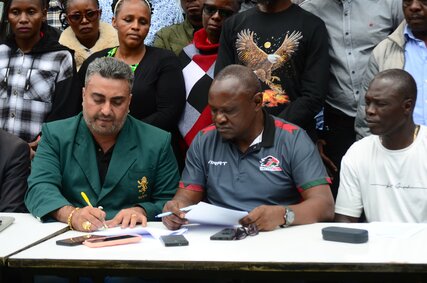
The decision was announced during a Special General Meeting (SGM) in Nairobi on Sunday, where Council representative Michael Riwa read a statement declaring that Mukinginyi would take charge of “operations, assets, records, finances, and staff discipline.”
“Walter Trenk Mukinginyi is hereby appointed as the Interim CEO of Cricket Kenya with immediate effect,” Riwa said.
He added that senior staff currently on compulsory leave would remain out of office until ongoing investigations are complete.
The meeting also announced the disbandment of the Independent Elections Panel, accusing it of non-performance and lack of independence.
“The purported Independent Elections Panel is hereby disbanded for non-performance and lack of independence. A new Independent Elections Panel will be constituted within 30 days to oversee elections for the office of Vice-Chairman in accordance with the Constitution,” Riwa said.
In addition, a disciplinary committee has been formed to investigate allegations against staff, with a report expected within 21 days.
The Council further approved the AOS T20 tournament, giving the board a mandate to proceed with preparations after weeks of uncertainty.
“The AOS T20 tournament is approved and the board is mandated to proceed with preparations,” the statement said.
The SGM also declared that all nominated board members whose terms had expired must cease acting in an official capacity.
The statement, jointly signed by Chairman Manoj Patel, Treasurer Kennedy Obuya and Council representative Michael Riwa, framed the changes as necessary to “stabilise management and restore order.”
Yet, behind the official declarations lies a much deeper conflict that has paralysed the game’s administration.
Earlier this year, a court order arising from a petition by suspended board member Kalpesh Solanki restricted Cricket Kenya from holding an annual general meeting and taking certain decisions until the case is heard.
The legal cloud has fuelled boardroom divisions, with rival factions each claiming to act in the best interest of the federation.
Tensions boiled over in July when a majority of board members passed a vote of no confidence in Chairman Patel after auditors flagged financial concerns.
Despite this, Patel and Treasurer Obuya pressed ahead with plans for a new domestic franchise league in partnership with Arena of Sports (AOS), unveiling the project in August.
The league, dubbed the CKT20, was meant to inject fresh energy into Kenyan cricket and attract private investment.
But CEO Ronald Bukusi publicly disowned the deal, warning that it had not been sanctioned by the International Cricket Council (ICC).
Without an ICC No Objection Certificate, the tournament risked leaving players and organisers open to sanctions.
On 10 September, Bukusi’s camp announced the termination of the AOS agreement, citing “grave breaches of governance,” alleged attempts to influence board members and the absence of ICC approval.
“This is not a legitimate event in the eyes of the ICC,” Bukusi insisted in statements.
The Patel-Obuya camp, however, insisted the CKT20 would go ahead and accused their opponents of stalling progress.
The dispute reached Sunday’s SGM, where Mukinginyi’s appointment and the green light for the tournament were formalised by one side of the divided board.
The ICC has not yet publicly commented on the rival claims, but the global body’s rules require all sanctioned domestic leagues to be cleared through established governance channels.
Analysts warn that any move to bypass those requirements could further damage Kenyan cricket’s credibility.
Once a World Cup semi-finalist in 2003, Kenya has struggled for years with administrative in-fighting, dwindling funding and declining performance on the pitch.
The latest rift has only deepened fears that sponsors and development partners will remain hesitant until governance is settled.
For now, the big questions remain unanswered: which faction has the legitimate authority to steer Cricket Kenya, whether the ICC will recognise any of the contested decisions, and how long the courts will take to resolve pending cases.
Until then, Walter Trenk Mukinginyi begins work as interim CEO in an office that may be as divided as the board that appointed him.